This does what it says on the tin! Welcome to the blog on my Masters in Design year. This is my day to day work on my project on the impact of computerisation on comic books.
Sunday, 13 December 2009
More dual medium: mixing realities
Here's a few more dual medium (picture and graphic tablet drawn stickmen) That I've been experimenting with.
I really like the brush effect done on this one. It looks a lot like the 1.5 mm fountain pen I use in my hand-drawn comics. On the opposite, there is the following picture done with a the basic brush from Adobe Illustrator.
Thursday, 10 December 2009
On writing with Alexandra Kokoli
On writing with Alexandra Kokoli - 3/12/09 and 10/12/09
With Alexandra Kokoli, we were invited to a seminar on writing as an artist spread out over two sessions. In the first session, we looked into the work of Susan Heiler. Looking into the texts, one can see facts in each one have a different focus and perspective. We also looked at texts the using Derrida's method explained in his quote "il n'y a pas d'hors texte", or in English "nothing is outside of text", which is a way of saying that everything is text and open for interpretation.
The vision of having no such thing as "hors texte" is a principle that seems to have been created for design. In my comics, the white space is not directly part of the comic, but in itself reflects choices to leave empty room, to leave simple void around the characters creating its own invisible grid in the comic. Every time a choice is made in the artistic domain, even if it's a choice that is held as meaningless by the author, it will be interpreted. Non-choices are also open for interpretations: by choosing to use a white background in my comics, I chose not to put a visible grid, the choice not to put a grid is one not visible straight away, but one as open to interpretation as the choice of having just a white background.
Alexandra then talked about Walter Benjamin, an adept of the Frankfurt School. Walter Benjamin addressed the subject of the inexistence of a "pure language", a language that covers all possibilities of communication. The concept of pure language appeared to be something easily grasped by those who were bilingual. Using French and English as examples we can show they are not pure languages by simply observing that the vocabulary in English for anything regarding the five senses is much more expanded that the one in French, but the French vocabulary has a wider expression gage for moods. When Walter Benjamin talks about language, and when Derrida talks about texts, they do not mean the purely word based language, but any artistic expression, like Rolland Bartes' myth.
This theory is perfectly applied to the mixed-media comics I have done. By mixing the languages of photography and digitally drawn stickmen, I combine the two languages' possibilities to create a new message that uses the "vocabulary" from both. By mixing the media, analogue and digital, hand drawn and graphic tablet drawn, backgrounds, white spaces and photos, I create a new message. The combination of each message and each medium creates a whole new message which a unique medium could not have achieved because of its limited range.
In the second session, we looked quite closely at artist statements and artist manifestos. We went through the list of what should be contained in an artist statement, and then created as a group our own list of what should be in an artist statement.
The artist statement should contain:
1. Intent
2. Context in the world
3. Context in the art world
4. Context in our own world
5. Critical context
6. Track Record
When the group read their statements and worked on them, a clear line appeared separating designers' statements and artist's statements. The fine art students seemed to be looking inward, up themselves, and the designers had more of an outward look covering what they could do in the future and how they could do for a client.
The difficulty I found in making a statement was that it had to define your way of working and creating art. I do not have a define technique I am trying to perfect for my art or designs, rather preferred methods and subjects. As a designer, being versatile is a very helpful trait, and over specialising is a weakness as being able to adapt to a client's requirements is essential.
After working through each other's statements, we created a list of what a good statement should be, and what it should not contain:
1. Shouldn't overshadow the work
2. Aware of the exhibition's context (to abide by or subvert - must be aware of the reader)
3. Clarity - Jargon and pretension free
4. Considered and purposeful presentation
5. Help to the understanding of the work
6. Must not over-explain
7. Need not hit all the categories
8. Support the work
Artist statements in our context are very much in the area of an exhibition and for the purpose of an exhibition. In the world of comic books, the work, comics, are produced to be published. The intent in creating a comic book is to have it published so it will reach a maximum amount of readers. In other words, the artistic statement behind a comic books is simply to tell a story to others. Every statement I have come across in the comic book world are closer to the designer statements: the artist justifies why he designed the story, layout, visual, text, grid, colours,... to fit the narration. Comic book exhibitions do exist, but the artwork shown was not created with the idea of an exhibition in mind but simply with the idea of letting the readers of comic books see the original work of the artists.
In the case of my comic books, my statement is brief and clear: tell my story in the most basic comic book visual design possible, and express the maximum of emotions, events and feelings with the minimum of artwork. Although my work is not created with the idea of that statement in mind, I see this as more of a technical statement than an artist statement. In the list of what a statement should be that our group created, the first principle of the statement not overshadowing the work would be my primary concern.
With Alexandra Kokoli, we were invited to a seminar on writing as an artist spread out over two sessions. In the first session, we looked into the work of Susan Heiler. Looking into the texts, one can see facts in each one have a different focus and perspective. We also looked at texts the using Derrida's method explained in his quote "il n'y a pas d'hors texte", or in English "nothing is outside of text", which is a way of saying that everything is text and open for interpretation.
The vision of having no such thing as "hors texte" is a principle that seems to have been created for design. In my comics, the white space is not directly part of the comic, but in itself reflects choices to leave empty room, to leave simple void around the characters creating its own invisible grid in the comic. Every time a choice is made in the artistic domain, even if it's a choice that is held as meaningless by the author, it will be interpreted. Non-choices are also open for interpretations: by choosing to use a white background in my comics, I chose not to put a visible grid, the choice not to put a grid is one not visible straight away, but one as open to interpretation as the choice of having just a white background.
Alexandra then talked about Walter Benjamin, an adept of the Frankfurt School. Walter Benjamin addressed the subject of the inexistence of a "pure language", a language that covers all possibilities of communication. The concept of pure language appeared to be something easily grasped by those who were bilingual. Using French and English as examples we can show they are not pure languages by simply observing that the vocabulary in English for anything regarding the five senses is much more expanded that the one in French, but the French vocabulary has a wider expression gage for moods. When Walter Benjamin talks about language, and when Derrida talks about texts, they do not mean the purely word based language, but any artistic expression, like Rolland Bartes' myth.
This theory is perfectly applied to the mixed-media comics I have done. By mixing the languages of photography and digitally drawn stickmen, I combine the two languages' possibilities to create a new message that uses the "vocabulary" from both. By mixing the media, analogue and digital, hand drawn and graphic tablet drawn, backgrounds, white spaces and photos, I create a new message. The combination of each message and each medium creates a whole new message which a unique medium could not have achieved because of its limited range.
In the second session, we looked quite closely at artist statements and artist manifestos. We went through the list of what should be contained in an artist statement, and then created as a group our own list of what should be in an artist statement.
The artist statement should contain:
1. Intent
2. Context in the world
3. Context in the art world
4. Context in our own world
5. Critical context
6. Track Record
When the group read their statements and worked on them, a clear line appeared separating designers' statements and artist's statements. The fine art students seemed to be looking inward, up themselves, and the designers had more of an outward look covering what they could do in the future and how they could do for a client.
The difficulty I found in making a statement was that it had to define your way of working and creating art. I do not have a define technique I am trying to perfect for my art or designs, rather preferred methods and subjects. As a designer, being versatile is a very helpful trait, and over specialising is a weakness as being able to adapt to a client's requirements is essential.
After working through each other's statements, we created a list of what a good statement should be, and what it should not contain:
1. Shouldn't overshadow the work
2. Aware of the exhibition's context (to abide by or subvert - must be aware of the reader)
3. Clarity - Jargon and pretension free
4. Considered and purposeful presentation
5. Help to the understanding of the work
6. Must not over-explain
7. Need not hit all the categories
8. Support the work
Artist statements in our context are very much in the area of an exhibition and for the purpose of an exhibition. In the world of comic books, the work, comics, are produced to be published. The intent in creating a comic book is to have it published so it will reach a maximum amount of readers. In other words, the artistic statement behind a comic books is simply to tell a story to others. Every statement I have come across in the comic book world are closer to the designer statements: the artist justifies why he designed the story, layout, visual, text, grid, colours,... to fit the narration. Comic book exhibitions do exist, but the artwork shown was not created with the idea of an exhibition in mind but simply with the idea of letting the readers of comic books see the original work of the artists.
In the case of my comic books, my statement is brief and clear: tell my story in the most basic comic book visual design possible, and express the maximum of emotions, events and feelings with the minimum of artwork. Although my work is not created with the idea of that statement in mind, I see this as more of a technical statement than an artist statement. In the list of what a statement should be that our group created, the first principle of the statement not overshadowing the work would be my primary concern.
Wednesday, 9 December 2009
Angoulème 2010
Angoulème is the city for comic books in Europe. It's in the south-west-ish of France, not over 3h from Paris, and is home to the comic book school of France as well as the second biggest comic book festival in the world (the first being the San Diego Comic Con). Each year at Angoulème there's the Festival de la BD d'Angoulème which is a 4 day event this year from the 28th of January to the 31st. There is also what is known as the biggest intellectual comic book award. The way the press and the comic book publishing world see things is that Europe is home to the intellectual comic books of the world, such as the Persepolis (the film adaptation was nominated for the Oscars) and last year's winner of the Angoulème festival Pinocchio by Winshluss.
Here you can find the list of the 48 nominees for this year's Angoulème comic book competition.
In the list, I'm quite a partisan of Daniel Clowes' Eight Ball, and unfortunately, not having been in France since the last festival, I don't know many of the comic books listed, and with my newly acquired title as "art student" I have to take in the financial burden of having pecuniary problems stopping me from getting some of these great titles imported from France.
Keeping in touch is quite important, especially with the European comic books as they are suppose to be the "artistic" comic books. That doesn't mean that the UK or the USA don't have artistic comic books, it's just the reputation European comic books have. Daniel Clowes is an American in this year's selection. When Chris Ware's Rusty Brown will be translated in French, I'm sure it'll be in the selection, he won the competition with Jimmy Corrigan, the Smartest Kid on Earth.
Here you can find the list of the 48 nominees for this year's Angoulème comic book competition.
In the list, I'm quite a partisan of Daniel Clowes' Eight Ball, and unfortunately, not having been in France since the last festival, I don't know many of the comic books listed, and with my newly acquired title as "art student" I have to take in the financial burden of having pecuniary problems stopping me from getting some of these great titles imported from France.
Keeping in touch is quite important, especially with the European comic books as they are suppose to be the "artistic" comic books. That doesn't mean that the UK or the USA don't have artistic comic books, it's just the reputation European comic books have. Daniel Clowes is an American in this year's selection. When Chris Ware's Rusty Brown will be translated in French, I'm sure it'll be in the selection, he won the competition with Jimmy Corrigan, the Smartest Kid on Earth.
Artwork: black and white space
Here's some of the black and white very simple stick figure designs I've been working on. I have added a personal tone by narrating as myself and talking about my personal life. It's still a bit new to me doing autobiographical comics. Actually, publishing comics about myself is what is new. I've been working on comics which are more personal, and which are very much inspired from Harvey Pekar's American Splendor. Writing about myself isn't the hardest things but making everything public is actually quite complex on a personal level.
Monday, 7 December 2009
Telling my story
After reflections and discussions with Tom and Joanne, I found the best and simplest way to sum up my research. I want to look into comic book narrative and how computers have democratised access to all to tell their story in comic book form.
Most of the web-comics out on the internet right now which are successful are by self taught people. Artists who have managed to get hold of a graphics tablet and a software to draw on. But that's not all that's needed from these self taught comic book artists: it's the art of designing a comic book narration.
Comic books are a whole bunch of different design styles all squeezed on a page. Design is involved throughout each step of the creative process. Comic books have very particular reading rules, because when one opens a comic book, you can see the whole narrative of a double page spread in a glance, and a successful comic book design should allow the reader to follow the plot in a way which can be read using shear logic. Good comic book design lets no ambiguity in the order of reading, in the way of reading and in the method of interpretation.
The message is in itself something completely different from the design, although a good message will be enhanced by good design and vice-versa. The comic book design start with the page layout, then goes to the square by square correlation between the images on the page in the grid layout. The interaction of each square with another is essential. Then inside each square a narrative of its own take place which involves designing efficiently the image, text and balloon layout so that the story can be read easily. The placement of the speech balloons is somewhat of a design art in itself because it has to take into consideration reading rules: in the English language (for example) we read from left to right, then from top to bottom, therefore a logical layout has to be made considering this and also allowing the narration to be in the logical place.
Now computers have allowed anyone to make comic books even if the computer is only used as a publishing medium. Anyone can publish there web-comics online. Also good design is necessary if one wants to be able to be read.
Most of the web-comics out on the internet right now which are successful are by self taught people. Artists who have managed to get hold of a graphics tablet and a software to draw on. But that's not all that's needed from these self taught comic book artists: it's the art of designing a comic book narration.
Comic books are a whole bunch of different design styles all squeezed on a page. Design is involved throughout each step of the creative process. Comic books have very particular reading rules, because when one opens a comic book, you can see the whole narrative of a double page spread in a glance, and a successful comic book design should allow the reader to follow the plot in a way which can be read using shear logic. Good comic book design lets no ambiguity in the order of reading, in the way of reading and in the method of interpretation.
The message is in itself something completely different from the design, although a good message will be enhanced by good design and vice-versa. The comic book design start with the page layout, then goes to the square by square correlation between the images on the page in the grid layout. The interaction of each square with another is essential. Then inside each square a narrative of its own take place which involves designing efficiently the image, text and balloon layout so that the story can be read easily. The placement of the speech balloons is somewhat of a design art in itself because it has to take into consideration reading rules: in the English language (for example) we read from left to right, then from top to bottom, therefore a logical layout has to be made considering this and also allowing the narration to be in the logical place.
Now computers have allowed anyone to make comic books even if the computer is only used as a publishing medium. Anyone can publish there web-comics online. Also good design is necessary if one wants to be able to be read.
Sunday, 6 December 2009
Stickmen, white space, and the internet
Stickmen, stickmen, stickmen... They are all over my comics. Why? Well one answer is because I can't draw anything else... but I asked myself a quite important question: if I could draw other things, would I? No. I would not. I like drawing stickmen, and they are an essential part of my comic book design. They fit into my storytelling, my use of grids and my experimentations, especially with white spaces and photographies.
Stickmen, and basic drawings seem to be part of this new era of webcomics. With the internet as the biggest publishing medium in the world, the democratisation of software through piracy and the low cost of hardware, anyone can pick up a graphics tablet, do a stickman, and narrate away in comic book format. Despite the basic artwork, these comics work because the stories and the design go hand in hand with the stickmen.
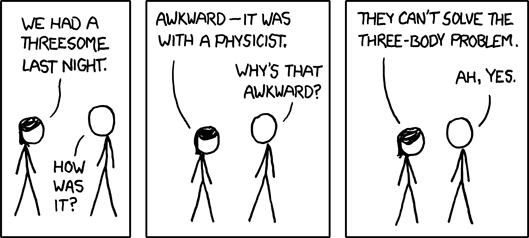
xkcd are very popular:
And white ninja has had quite a success:
And Cyanide & Happiness just had a book published as a compilation of their best comics:
Would these work as well if they didn't have low quality drawings? I don't think so. The artwork, the simplicity and the white space is what makes these comics loveable. The comedy and the joke is told as much by the appearance of the characters as by the action development (grid/layout) as by the text.
"The visual representation of the characters will of course, depend on the artists inherent style. This can mean that the design may consist of anything from a stick figure to a fully rendered or photo-realistically painted character." Gary Spencer Millidge, Comic Book Design, p.16, Watson Gutwill: New York, 2009.
Lewis Trondheim, a very well know and respected French comic book artist, which has done such things as A.L.I.E.E.E.N. that has been translated into English, as well as the cat symbol of the Festival de la BD d'Agoulème, the Trondheim cat; has always had a style described as "pared-down cartooning to design different-looking extraterrestial monsters with just a few lines" (p.17, Millidge, G.S., 2009)
Above: A.L.I.E.E.E.N. and The Angoulème Cat by Tronheim.
On the simple character design and comedy side of things, others have managed to become quite well know on good design through comedy, good writting, and great and simple characters.
Simon's Cat, by Simon Tofeild, has just had a book of short comics published, but the cat initially started as short videos on YouTube:
Garry Larson's The Far Side doesn't need any introduction:
And Andy Riley's Suicidal Rabbits (The Bunny Suicides) born and bred in the U.K. are a endless source of joy and he is described as the British Gary larson:
I have myself been experimenting further with white space, stickmen, simplicity, and comedy.
Stickmen, and basic drawings seem to be part of this new era of webcomics. With the internet as the biggest publishing medium in the world, the democratisation of software through piracy and the low cost of hardware, anyone can pick up a graphics tablet, do a stickman, and narrate away in comic book format. Despite the basic artwork, these comics work because the stories and the design go hand in hand with the stickmen.
xkcd are very popular:
And white ninja has had quite a success:
And Cyanide & Happiness just had a book published as a compilation of their best comics:
Would these work as well if they didn't have low quality drawings? I don't think so. The artwork, the simplicity and the white space is what makes these comics loveable. The comedy and the joke is told as much by the appearance of the characters as by the action development (grid/layout) as by the text.
"The visual representation of the characters will of course, depend on the artists inherent style. This can mean that the design may consist of anything from a stick figure to a fully rendered or photo-realistically painted character." Gary Spencer Millidge, Comic Book Design, p.16, Watson Gutwill: New York, 2009.
Lewis Trondheim, a very well know and respected French comic book artist, which has done such things as A.L.I.E.E.E.N. that has been translated into English, as well as the cat symbol of the Festival de la BD d'Agoulème, the Trondheim cat; has always had a style described as "pared-down cartooning to design different-looking extraterrestial monsters with just a few lines" (p.17, Millidge, G.S., 2009)
Above: A.L.I.E.E.E.N. and The Angoulème Cat by Tronheim.
On the simple character design and comedy side of things, others have managed to become quite well know on good design through comedy, good writting, and great and simple characters.
Simon's Cat, by Simon Tofeild, has just had a book of short comics published, but the cat initially started as short videos on YouTube:
Garry Larson's The Far Side doesn't need any introduction:
And Andy Riley's Suicidal Rabbits (The Bunny Suicides) born and bred in the U.K. are a endless source of joy and he is described as the British Gary larson:
I have myself been experimenting further with white space, stickmen, simplicity, and comedy.
This one's quite Gary Larson-y in style...
Tuesday, 1 December 2009
What is comic book design: covering the basics
"What is design?
Design is an ever-present aspect of modern life. Everything from product packaging to cars, phones, newspapers, cars, phones, newspapers, websites, shop fronts, clothing, advertising, television, and the programs that appear on them has been to conscious and deliberate design.
More specifically, graphic design is said to be all about visual communication, and presentation, a discipline which combines symbols, images, and/or words to express ideas and messages.
That's not a bad definition of comics itself." Gary Spencer Millidge, Comic Book Design, p.8, Watson Guptill: New York, 2009
That isn't a bad definition of comic books, mainly because comic books are all about design. From character and location design to lettering and balloons passing by page layouts and visual storytelling (all covered in the book Comic Book Designs) comic books are about design. What makes them so close to design is they merge both written storytelling and artistic visual display.
When one looks at a comic book page, what can be seen is an obvious use of a grid, which is an important part of the visual style and storytelling. Then, looking into each square of the comics, one can see another type of grid mixing in a logical and efficient way the textual narration, the speech balloons and the graphic artwork. The design of the comic book has one main goal: telling a story. That's what comic books, and books do, tell a story.
Good comic design doesn't only tell a story, it tells it well. The writing, the scenario, that is all about effectiveness, but the design brings the efficiency to the comics. By designing the comic book page to designing the characters, all matters to tell the comic's story. Different design styles exist, and design has to work hand in hand with the story, the plot, the scenario and the artwork to do its job as perfectly as possible.
Subscribe to:
Comments (Atom)