This does what it says on the tin! Welcome to the blog on my Masters in Design year. This is my day to day work on my project on the impact of computerisation on comic books.
Sunday, 13 December 2009
More dual medium: mixing realities
Here's a few more dual medium (picture and graphic tablet drawn stickmen) That I've been experimenting with.
I really like the brush effect done on this one. It looks a lot like the 1.5 mm fountain pen I use in my hand-drawn comics. On the opposite, there is the following picture done with a the basic brush from Adobe Illustrator.
Thursday, 10 December 2009
On writing with Alexandra Kokoli
On writing with Alexandra Kokoli - 3/12/09 and 10/12/09
With Alexandra Kokoli, we were invited to a seminar on writing as an artist spread out over two sessions. In the first session, we looked into the work of Susan Heiler. Looking into the texts, one can see facts in each one have a different focus and perspective. We also looked at texts the using Derrida's method explained in his quote "il n'y a pas d'hors texte", or in English "nothing is outside of text", which is a way of saying that everything is text and open for interpretation.
The vision of having no such thing as "hors texte" is a principle that seems to have been created for design. In my comics, the white space is not directly part of the comic, but in itself reflects choices to leave empty room, to leave simple void around the characters creating its own invisible grid in the comic. Every time a choice is made in the artistic domain, even if it's a choice that is held as meaningless by the author, it will be interpreted. Non-choices are also open for interpretations: by choosing to use a white background in my comics, I chose not to put a visible grid, the choice not to put a grid is one not visible straight away, but one as open to interpretation as the choice of having just a white background.
Alexandra then talked about Walter Benjamin, an adept of the Frankfurt School. Walter Benjamin addressed the subject of the inexistence of a "pure language", a language that covers all possibilities of communication. The concept of pure language appeared to be something easily grasped by those who were bilingual. Using French and English as examples we can show they are not pure languages by simply observing that the vocabulary in English for anything regarding the five senses is much more expanded that the one in French, but the French vocabulary has a wider expression gage for moods. When Walter Benjamin talks about language, and when Derrida talks about texts, they do not mean the purely word based language, but any artistic expression, like Rolland Bartes' myth.
This theory is perfectly applied to the mixed-media comics I have done. By mixing the languages of photography and digitally drawn stickmen, I combine the two languages' possibilities to create a new message that uses the "vocabulary" from both. By mixing the media, analogue and digital, hand drawn and graphic tablet drawn, backgrounds, white spaces and photos, I create a new message. The combination of each message and each medium creates a whole new message which a unique medium could not have achieved because of its limited range.
In the second session, we looked quite closely at artist statements and artist manifestos. We went through the list of what should be contained in an artist statement, and then created as a group our own list of what should be in an artist statement.
The artist statement should contain:
1. Intent
2. Context in the world
3. Context in the art world
4. Context in our own world
5. Critical context
6. Track Record
When the group read their statements and worked on them, a clear line appeared separating designers' statements and artist's statements. The fine art students seemed to be looking inward, up themselves, and the designers had more of an outward look covering what they could do in the future and how they could do for a client.
The difficulty I found in making a statement was that it had to define your way of working and creating art. I do not have a define technique I am trying to perfect for my art or designs, rather preferred methods and subjects. As a designer, being versatile is a very helpful trait, and over specialising is a weakness as being able to adapt to a client's requirements is essential.
After working through each other's statements, we created a list of what a good statement should be, and what it should not contain:
1. Shouldn't overshadow the work
2. Aware of the exhibition's context (to abide by or subvert - must be aware of the reader)
3. Clarity - Jargon and pretension free
4. Considered and purposeful presentation
5. Help to the understanding of the work
6. Must not over-explain
7. Need not hit all the categories
8. Support the work
Artist statements in our context are very much in the area of an exhibition and for the purpose of an exhibition. In the world of comic books, the work, comics, are produced to be published. The intent in creating a comic book is to have it published so it will reach a maximum amount of readers. In other words, the artistic statement behind a comic books is simply to tell a story to others. Every statement I have come across in the comic book world are closer to the designer statements: the artist justifies why he designed the story, layout, visual, text, grid, colours,... to fit the narration. Comic book exhibitions do exist, but the artwork shown was not created with the idea of an exhibition in mind but simply with the idea of letting the readers of comic books see the original work of the artists.
In the case of my comic books, my statement is brief and clear: tell my story in the most basic comic book visual design possible, and express the maximum of emotions, events and feelings with the minimum of artwork. Although my work is not created with the idea of that statement in mind, I see this as more of a technical statement than an artist statement. In the list of what a statement should be that our group created, the first principle of the statement not overshadowing the work would be my primary concern.
With Alexandra Kokoli, we were invited to a seminar on writing as an artist spread out over two sessions. In the first session, we looked into the work of Susan Heiler. Looking into the texts, one can see facts in each one have a different focus and perspective. We also looked at texts the using Derrida's method explained in his quote "il n'y a pas d'hors texte", or in English "nothing is outside of text", which is a way of saying that everything is text and open for interpretation.
The vision of having no such thing as "hors texte" is a principle that seems to have been created for design. In my comics, the white space is not directly part of the comic, but in itself reflects choices to leave empty room, to leave simple void around the characters creating its own invisible grid in the comic. Every time a choice is made in the artistic domain, even if it's a choice that is held as meaningless by the author, it will be interpreted. Non-choices are also open for interpretations: by choosing to use a white background in my comics, I chose not to put a visible grid, the choice not to put a grid is one not visible straight away, but one as open to interpretation as the choice of having just a white background.
Alexandra then talked about Walter Benjamin, an adept of the Frankfurt School. Walter Benjamin addressed the subject of the inexistence of a "pure language", a language that covers all possibilities of communication. The concept of pure language appeared to be something easily grasped by those who were bilingual. Using French and English as examples we can show they are not pure languages by simply observing that the vocabulary in English for anything regarding the five senses is much more expanded that the one in French, but the French vocabulary has a wider expression gage for moods. When Walter Benjamin talks about language, and when Derrida talks about texts, they do not mean the purely word based language, but any artistic expression, like Rolland Bartes' myth.
This theory is perfectly applied to the mixed-media comics I have done. By mixing the languages of photography and digitally drawn stickmen, I combine the two languages' possibilities to create a new message that uses the "vocabulary" from both. By mixing the media, analogue and digital, hand drawn and graphic tablet drawn, backgrounds, white spaces and photos, I create a new message. The combination of each message and each medium creates a whole new message which a unique medium could not have achieved because of its limited range.
In the second session, we looked quite closely at artist statements and artist manifestos. We went through the list of what should be contained in an artist statement, and then created as a group our own list of what should be in an artist statement.
The artist statement should contain:
1. Intent
2. Context in the world
3. Context in the art world
4. Context in our own world
5. Critical context
6. Track Record
When the group read their statements and worked on them, a clear line appeared separating designers' statements and artist's statements. The fine art students seemed to be looking inward, up themselves, and the designers had more of an outward look covering what they could do in the future and how they could do for a client.
The difficulty I found in making a statement was that it had to define your way of working and creating art. I do not have a define technique I am trying to perfect for my art or designs, rather preferred methods and subjects. As a designer, being versatile is a very helpful trait, and over specialising is a weakness as being able to adapt to a client's requirements is essential.
After working through each other's statements, we created a list of what a good statement should be, and what it should not contain:
1. Shouldn't overshadow the work
2. Aware of the exhibition's context (to abide by or subvert - must be aware of the reader)
3. Clarity - Jargon and pretension free
4. Considered and purposeful presentation
5. Help to the understanding of the work
6. Must not over-explain
7. Need not hit all the categories
8. Support the work
Artist statements in our context are very much in the area of an exhibition and for the purpose of an exhibition. In the world of comic books, the work, comics, are produced to be published. The intent in creating a comic book is to have it published so it will reach a maximum amount of readers. In other words, the artistic statement behind a comic books is simply to tell a story to others. Every statement I have come across in the comic book world are closer to the designer statements: the artist justifies why he designed the story, layout, visual, text, grid, colours,... to fit the narration. Comic book exhibitions do exist, but the artwork shown was not created with the idea of an exhibition in mind but simply with the idea of letting the readers of comic books see the original work of the artists.
In the case of my comic books, my statement is brief and clear: tell my story in the most basic comic book visual design possible, and express the maximum of emotions, events and feelings with the minimum of artwork. Although my work is not created with the idea of that statement in mind, I see this as more of a technical statement than an artist statement. In the list of what a statement should be that our group created, the first principle of the statement not overshadowing the work would be my primary concern.
Wednesday, 9 December 2009
Angoulème 2010
Angoulème is the city for comic books in Europe. It's in the south-west-ish of France, not over 3h from Paris, and is home to the comic book school of France as well as the second biggest comic book festival in the world (the first being the San Diego Comic Con). Each year at Angoulème there's the Festival de la BD d'Angoulème which is a 4 day event this year from the 28th of January to the 31st. There is also what is known as the biggest intellectual comic book award. The way the press and the comic book publishing world see things is that Europe is home to the intellectual comic books of the world, such as the Persepolis (the film adaptation was nominated for the Oscars) and last year's winner of the Angoulème festival Pinocchio by Winshluss.
Here you can find the list of the 48 nominees for this year's Angoulème comic book competition.
In the list, I'm quite a partisan of Daniel Clowes' Eight Ball, and unfortunately, not having been in France since the last festival, I don't know many of the comic books listed, and with my newly acquired title as "art student" I have to take in the financial burden of having pecuniary problems stopping me from getting some of these great titles imported from France.
Keeping in touch is quite important, especially with the European comic books as they are suppose to be the "artistic" comic books. That doesn't mean that the UK or the USA don't have artistic comic books, it's just the reputation European comic books have. Daniel Clowes is an American in this year's selection. When Chris Ware's Rusty Brown will be translated in French, I'm sure it'll be in the selection, he won the competition with Jimmy Corrigan, the Smartest Kid on Earth.
Here you can find the list of the 48 nominees for this year's Angoulème comic book competition.
In the list, I'm quite a partisan of Daniel Clowes' Eight Ball, and unfortunately, not having been in France since the last festival, I don't know many of the comic books listed, and with my newly acquired title as "art student" I have to take in the financial burden of having pecuniary problems stopping me from getting some of these great titles imported from France.
Keeping in touch is quite important, especially with the European comic books as they are suppose to be the "artistic" comic books. That doesn't mean that the UK or the USA don't have artistic comic books, it's just the reputation European comic books have. Daniel Clowes is an American in this year's selection. When Chris Ware's Rusty Brown will be translated in French, I'm sure it'll be in the selection, he won the competition with Jimmy Corrigan, the Smartest Kid on Earth.
Artwork: black and white space
Here's some of the black and white very simple stick figure designs I've been working on. I have added a personal tone by narrating as myself and talking about my personal life. It's still a bit new to me doing autobiographical comics. Actually, publishing comics about myself is what is new. I've been working on comics which are more personal, and which are very much inspired from Harvey Pekar's American Splendor. Writing about myself isn't the hardest things but making everything public is actually quite complex on a personal level.
Monday, 7 December 2009
Telling my story
After reflections and discussions with Tom and Joanne, I found the best and simplest way to sum up my research. I want to look into comic book narrative and how computers have democratised access to all to tell their story in comic book form.
Most of the web-comics out on the internet right now which are successful are by self taught people. Artists who have managed to get hold of a graphics tablet and a software to draw on. But that's not all that's needed from these self taught comic book artists: it's the art of designing a comic book narration.
Comic books are a whole bunch of different design styles all squeezed on a page. Design is involved throughout each step of the creative process. Comic books have very particular reading rules, because when one opens a comic book, you can see the whole narrative of a double page spread in a glance, and a successful comic book design should allow the reader to follow the plot in a way which can be read using shear logic. Good comic book design lets no ambiguity in the order of reading, in the way of reading and in the method of interpretation.
The message is in itself something completely different from the design, although a good message will be enhanced by good design and vice-versa. The comic book design start with the page layout, then goes to the square by square correlation between the images on the page in the grid layout. The interaction of each square with another is essential. Then inside each square a narrative of its own take place which involves designing efficiently the image, text and balloon layout so that the story can be read easily. The placement of the speech balloons is somewhat of a design art in itself because it has to take into consideration reading rules: in the English language (for example) we read from left to right, then from top to bottom, therefore a logical layout has to be made considering this and also allowing the narration to be in the logical place.
Now computers have allowed anyone to make comic books even if the computer is only used as a publishing medium. Anyone can publish there web-comics online. Also good design is necessary if one wants to be able to be read.
Most of the web-comics out on the internet right now which are successful are by self taught people. Artists who have managed to get hold of a graphics tablet and a software to draw on. But that's not all that's needed from these self taught comic book artists: it's the art of designing a comic book narration.
Comic books are a whole bunch of different design styles all squeezed on a page. Design is involved throughout each step of the creative process. Comic books have very particular reading rules, because when one opens a comic book, you can see the whole narrative of a double page spread in a glance, and a successful comic book design should allow the reader to follow the plot in a way which can be read using shear logic. Good comic book design lets no ambiguity in the order of reading, in the way of reading and in the method of interpretation.
The message is in itself something completely different from the design, although a good message will be enhanced by good design and vice-versa. The comic book design start with the page layout, then goes to the square by square correlation between the images on the page in the grid layout. The interaction of each square with another is essential. Then inside each square a narrative of its own take place which involves designing efficiently the image, text and balloon layout so that the story can be read easily. The placement of the speech balloons is somewhat of a design art in itself because it has to take into consideration reading rules: in the English language (for example) we read from left to right, then from top to bottom, therefore a logical layout has to be made considering this and also allowing the narration to be in the logical place.
Now computers have allowed anyone to make comic books even if the computer is only used as a publishing medium. Anyone can publish there web-comics online. Also good design is necessary if one wants to be able to be read.
Sunday, 6 December 2009
Stickmen, white space, and the internet
Stickmen, stickmen, stickmen... They are all over my comics. Why? Well one answer is because I can't draw anything else... but I asked myself a quite important question: if I could draw other things, would I? No. I would not. I like drawing stickmen, and they are an essential part of my comic book design. They fit into my storytelling, my use of grids and my experimentations, especially with white spaces and photographies.
Stickmen, and basic drawings seem to be part of this new era of webcomics. With the internet as the biggest publishing medium in the world, the democratisation of software through piracy and the low cost of hardware, anyone can pick up a graphics tablet, do a stickman, and narrate away in comic book format. Despite the basic artwork, these comics work because the stories and the design go hand in hand with the stickmen.
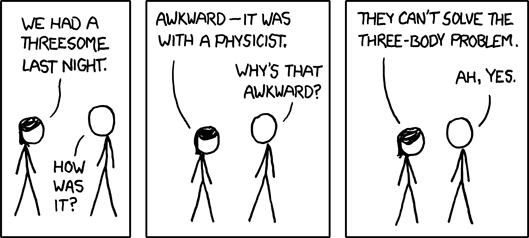
xkcd are very popular:
And white ninja has had quite a success:
And Cyanide & Happiness just had a book published as a compilation of their best comics:
Would these work as well if they didn't have low quality drawings? I don't think so. The artwork, the simplicity and the white space is what makes these comics loveable. The comedy and the joke is told as much by the appearance of the characters as by the action development (grid/layout) as by the text.
"The visual representation of the characters will of course, depend on the artists inherent style. This can mean that the design may consist of anything from a stick figure to a fully rendered or photo-realistically painted character." Gary Spencer Millidge, Comic Book Design, p.16, Watson Gutwill: New York, 2009.
Lewis Trondheim, a very well know and respected French comic book artist, which has done such things as A.L.I.E.E.E.N. that has been translated into English, as well as the cat symbol of the Festival de la BD d'Agoulème, the Trondheim cat; has always had a style described as "pared-down cartooning to design different-looking extraterrestial monsters with just a few lines" (p.17, Millidge, G.S., 2009)
Above: A.L.I.E.E.E.N. and The Angoulème Cat by Tronheim.
On the simple character design and comedy side of things, others have managed to become quite well know on good design through comedy, good writting, and great and simple characters.
Simon's Cat, by Simon Tofeild, has just had a book of short comics published, but the cat initially started as short videos on YouTube:
Garry Larson's The Far Side doesn't need any introduction:
And Andy Riley's Suicidal Rabbits (The Bunny Suicides) born and bred in the U.K. are a endless source of joy and he is described as the British Gary larson:
I have myself been experimenting further with white space, stickmen, simplicity, and comedy.
Stickmen, and basic drawings seem to be part of this new era of webcomics. With the internet as the biggest publishing medium in the world, the democratisation of software through piracy and the low cost of hardware, anyone can pick up a graphics tablet, do a stickman, and narrate away in comic book format. Despite the basic artwork, these comics work because the stories and the design go hand in hand with the stickmen.
xkcd are very popular:
And white ninja has had quite a success:
And Cyanide & Happiness just had a book published as a compilation of their best comics:
Would these work as well if they didn't have low quality drawings? I don't think so. The artwork, the simplicity and the white space is what makes these comics loveable. The comedy and the joke is told as much by the appearance of the characters as by the action development (grid/layout) as by the text.
"The visual representation of the characters will of course, depend on the artists inherent style. This can mean that the design may consist of anything from a stick figure to a fully rendered or photo-realistically painted character." Gary Spencer Millidge, Comic Book Design, p.16, Watson Gutwill: New York, 2009.
Lewis Trondheim, a very well know and respected French comic book artist, which has done such things as A.L.I.E.E.E.N. that has been translated into English, as well as the cat symbol of the Festival de la BD d'Agoulème, the Trondheim cat; has always had a style described as "pared-down cartooning to design different-looking extraterrestial monsters with just a few lines" (p.17, Millidge, G.S., 2009)
Above: A.L.I.E.E.E.N. and The Angoulème Cat by Tronheim.
On the simple character design and comedy side of things, others have managed to become quite well know on good design through comedy, good writting, and great and simple characters.
Simon's Cat, by Simon Tofeild, has just had a book of short comics published, but the cat initially started as short videos on YouTube:
Garry Larson's The Far Side doesn't need any introduction:
And Andy Riley's Suicidal Rabbits (The Bunny Suicides) born and bred in the U.K. are a endless source of joy and he is described as the British Gary larson:
I have myself been experimenting further with white space, stickmen, simplicity, and comedy.
This one's quite Gary Larson-y in style...
Tuesday, 1 December 2009
What is comic book design: covering the basics
"What is design?
Design is an ever-present aspect of modern life. Everything from product packaging to cars, phones, newspapers, cars, phones, newspapers, websites, shop fronts, clothing, advertising, television, and the programs that appear on them has been to conscious and deliberate design.
More specifically, graphic design is said to be all about visual communication, and presentation, a discipline which combines symbols, images, and/or words to express ideas and messages.
That's not a bad definition of comics itself." Gary Spencer Millidge, Comic Book Design, p.8, Watson Guptill: New York, 2009
That isn't a bad definition of comic books, mainly because comic books are all about design. From character and location design to lettering and balloons passing by page layouts and visual storytelling (all covered in the book Comic Book Designs) comic books are about design. What makes them so close to design is they merge both written storytelling and artistic visual display.
When one looks at a comic book page, what can be seen is an obvious use of a grid, which is an important part of the visual style and storytelling. Then, looking into each square of the comics, one can see another type of grid mixing in a logical and efficient way the textual narration, the speech balloons and the graphic artwork. The design of the comic book has one main goal: telling a story. That's what comic books, and books do, tell a story.
Good comic design doesn't only tell a story, it tells it well. The writing, the scenario, that is all about effectiveness, but the design brings the efficiency to the comics. By designing the comic book page to designing the characters, all matters to tell the comic's story. Different design styles exist, and design has to work hand in hand with the story, the plot, the scenario and the artwork to do its job as perfectly as possible.
Thursday, 26 November 2009
Drawing outside
Drawing outside, in the cold, when we could have stayed inside - 26/11/09
During this week's seminar, we were asked to draw. There was no discussion, no introduction to the reason of the work we were asked to do. A brief was simply given to four teams of four. Our group studied the outdoors, a location outside, that we had to draw from different perspectives.
We went outside, to a location where the temperature was all but welcoming. We quickly decided on a spot where we would draw what we saw. Sitting down, I drew the background. I have to say, that as a designer, my drawing skills are very limited. I do not think I captured any of the "precious" essence of the location. This was more confusing than anything else. After drawing the area, drawing poorly I should actually say, we corded off a bit of the terrain we were representing in our drawings and focused on representing that on paper. Once again, my qualities in drawing did not seem to stand out, although I was told I was getting better. I felt very intimidated comparing my work to the one of the fine art students. Even Bianca had done drawing in first year of digital media.
Our representations of the corded location were very different, and the difference in our style only thickened when we went back to the studio and had to draw the location from memory. The only thing from the actual location I did want to put in my drawing from memory was a snail I created in the background of one of my drawings.
This seminar was most helpful to allow me to practice my imagination skills. Out of the most concrete situation, I created a stick-snail character which I hoped would distract from the rest of the drawing. This goes hand in hand with my comic book works. Comic books are a form of entertainment, and one of the prime roles of entertainment is to be distracted from reality, and taken into another world. The surreal of my Wally, the Evangelist snail, allows for those who would be bored by my drawings, or disturbed by my lake of skill to be able to be distracted from these harsh truths.
The seminar about nature and artistic interpretation of nature did not manage to get a lot out of me apart from my belief that all men need to be distracted from reality in order to be able to cope with everyday life. The possibility to be distracted for a bit from the cold of the outdoors, for example, allows stress relief and to be transported out of reality only to come back hopefully refreshed.
During this week's seminar, we were asked to draw. There was no discussion, no introduction to the reason of the work we were asked to do. A brief was simply given to four teams of four. Our group studied the outdoors, a location outside, that we had to draw from different perspectives.
We went outside, to a location where the temperature was all but welcoming. We quickly decided on a spot where we would draw what we saw. Sitting down, I drew the background. I have to say, that as a designer, my drawing skills are very limited. I do not think I captured any of the "precious" essence of the location. This was more confusing than anything else. After drawing the area, drawing poorly I should actually say, we corded off a bit of the terrain we were representing in our drawings and focused on representing that on paper. Once again, my qualities in drawing did not seem to stand out, although I was told I was getting better. I felt very intimidated comparing my work to the one of the fine art students. Even Bianca had done drawing in first year of digital media.
Our representations of the corded location were very different, and the difference in our style only thickened when we went back to the studio and had to draw the location from memory. The only thing from the actual location I did want to put in my drawing from memory was a snail I created in the background of one of my drawings.
This seminar was most helpful to allow me to practice my imagination skills. Out of the most concrete situation, I created a stick-snail character which I hoped would distract from the rest of the drawing. This goes hand in hand with my comic book works. Comic books are a form of entertainment, and one of the prime roles of entertainment is to be distracted from reality, and taken into another world. The surreal of my Wally, the Evangelist snail, allows for those who would be bored by my drawings, or disturbed by my lake of skill to be able to be distracted from these harsh truths.
The seminar about nature and artistic interpretation of nature did not manage to get a lot out of me apart from my belief that all men need to be distracted from reality in order to be able to cope with everyday life. The possibility to be distracted for a bit from the cold of the outdoors, for example, allows stress relief and to be transported out of reality only to come back hopefully refreshed.
Thursday, 19 November 2009
Anne Douglas on Paul Clay
Anne Douglas on Paul Clay – 19/11/09
Anne Douglas walked us through the works of Paul Clay. We analysed his drawings and were explained how Paul Clay saw drawing as the direct opposite of photography, and his vision of drawing as an extension of ourselves. We analysed the drawings of Paul Clay and tried to understand his view on the art of drawing. Anne Douglas explained from the start that her definition of “art” was “doing something supremely well”. One of the main focuses that we observed on Paul Clay’s drawings is the idea of referential: he called these the passive, the active and the medial. We were asked to produce a drawing ourselves illustrating a natural event that would take in consideration the referential system and the change in the active, passive and medial elements in our drawings. We then presented our drawings to the class and explained our referential system, and our representation of forces in the drawing. The class then commented not only on our representation but also on our drawing skills.
During our seminar, I tried to question Paul Clay, and could not stop be understand what he was doing what a form of pseudo-scientific representation. Paul Clay’s drawings bother me. For me, they are in direct contradiction with the definition of art given to us at the beginning of the seminar: art is doing something “supremely well”. Paul Clay does no seem to be doing his work supremely well in any perspective. His illustrations are merely pseudo-physics. The system he tries to represent with the water weal is just a very poor tae on the study of forces and referential which has been the method to analyse actions and reactions in the physics discipline for centuries. The physics idea is the same as Paul Clays with the only difference of having a consistent and logical norm of representation. When Paul Clay puts emphasis on one aspect of the forces applied to his schematics, he is simply changing the referential. In other words, he is just changing the “item” around which the whole force system is applied to.
In physics there are precise ways of drawing forces and applying them in relation to a referential. The simplest example is in the heliocentric referential, the earth goes around the Sun, but if we take the Earth as a referential, the sun is the other planets are the ones moving in an ellipsis around the Earth. Paul Clays drawings simply change referential by putting more emphasis on the water, the hammer, or the wheels.
The closest this application could be taken to my work is the importance of some items on others in the artistic representation and how one represents this emphasis. In comics, one can apply more or less emphasis on an item, an emotion or an event, and sometimes all three in the same situation consecutively. Paul Clay’s approach to drawing allows one to consider what he would like to have as the main referential in his drawing, allowing for a view of the drawing in different perspectives.
Anne Douglas walked us through the works of Paul Clay. We analysed his drawings and were explained how Paul Clay saw drawing as the direct opposite of photography, and his vision of drawing as an extension of ourselves. We analysed the drawings of Paul Clay and tried to understand his view on the art of drawing. Anne Douglas explained from the start that her definition of “art” was “doing something supremely well”. One of the main focuses that we observed on Paul Clay’s drawings is the idea of referential: he called these the passive, the active and the medial. We were asked to produce a drawing ourselves illustrating a natural event that would take in consideration the referential system and the change in the active, passive and medial elements in our drawings. We then presented our drawings to the class and explained our referential system, and our representation of forces in the drawing. The class then commented not only on our representation but also on our drawing skills.
During our seminar, I tried to question Paul Clay, and could not stop be understand what he was doing what a form of pseudo-scientific representation. Paul Clay’s drawings bother me. For me, they are in direct contradiction with the definition of art given to us at the beginning of the seminar: art is doing something “supremely well”. Paul Clay does no seem to be doing his work supremely well in any perspective. His illustrations are merely pseudo-physics. The system he tries to represent with the water weal is just a very poor tae on the study of forces and referential which has been the method to analyse actions and reactions in the physics discipline for centuries. The physics idea is the same as Paul Clays with the only difference of having a consistent and logical norm of representation. When Paul Clay puts emphasis on one aspect of the forces applied to his schematics, he is simply changing the referential. In other words, he is just changing the “item” around which the whole force system is applied to.
In physics there are precise ways of drawing forces and applying them in relation to a referential. The simplest example is in the heliocentric referential, the earth goes around the Sun, but if we take the Earth as a referential, the sun is the other planets are the ones moving in an ellipsis around the Earth. Paul Clays drawings simply change referential by putting more emphasis on the water, the hammer, or the wheels.
The closest this application could be taken to my work is the importance of some items on others in the artistic representation and how one represents this emphasis. In comics, one can apply more or less emphasis on an item, an emotion or an event, and sometimes all three in the same situation consecutively. Paul Clay’s approach to drawing allows one to consider what he would like to have as the main referential in his drawing, allowing for a view of the drawing in different perspectives.
Tuesday, 17 November 2009
Technological advances and comic books
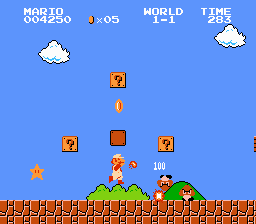
Why would video games be a good benchmark? Well simply because the comic book publishing world is far from being like the Hollywood film star world. The artists are quite humble in wealth, and resources. Comic book artists, like most published authors, work with their own means, so seeing what is available to the average family in terms of technology illustrates what's available to comic book artists. In other word, it's amazing Shatter managed to get created in 1985 when we compare it to the Nintendo games of the time.
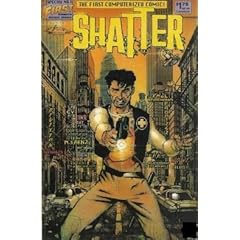
Shatter, by Peter B. Gillis and Mike Saenz, published by First Comics brags from the first issue in 1985 on the cover of being the first computerized comic. It was first published in Big K, a computer magazine which introduced Shatter as: "the world's first comics series entirely drawn on a computer" (Big K no. 6). The first look at the inside of Shatter and you can see the pixels and the computerised effects used to create it's unique touch. Mostly, what you'll discover when you open Shatter, is that the computerised style works incredibly well! It gives the whole comic a Blade Runner/Do Androids Dream of Electric Sheep? (Ridley Scott, and Philip K. Dick respectively). The artwork in Shatter brought forth the first demonstration that involving a computer in the comic book art process works. Or at least it works if you're willing to take advantage of the computer and not try to do exactly what you were doing on paper, but on a screen.
Comic book artist which I will refer too quite extensively throughout my research work, describes on his blog how he switched to working on and with a computer when working on comic books:
http://disraeli-demon.blogspot.com/2009/08/caption-2009-ten-years-in-digital-world.html
The digital age of comic books involves just a few things: a graphics tablet (now available in A5 size for about £70), Adobe Photoshop (or other similar programs) for colour work, Adobe Illustrator (or other similar programs) for the drawing and "inking", and a word processor, to put in the text and read the now digitalised scenarios. The technological advances we are getting now days for comic books don't consist of much more than bigger, better, faster and more precise graphic tablets, improved software and improved computer hardware (although nothing heavy duty is required). As home PCs and Macs get better every day, the computerisation of comic books gets simpler. Contemporary technological advances don't seem to improve the quality of comic books though because the hardware and software involved has not had breakthroughs since the democratisation of an affordable graphics tablet. The changes made in the recent software and hardware just make working on a computer ever so slightly easier, faster, and more user friendly and adaptable, as well as portable, and this is mainly because of prices. Now most homes have a printer and a scanner which can scan in a good resolution and 300dpi, and graphic tablets are affordable. Therefore, any comic artist has the tools easily available for him to take his comics into "the digital age".
Thursday, 12 November 2009
François Matarasso
François Matarasso – 12/11/09
During our seminar with François Matarasso we discussed how the government discusses about the quality of art, and how they use these discussions to decide on their funding and censorship of art. François Matarasso explained to us how he was the one charged of finding the criteria to base the discussions on the quality or art produced by individuals or groups funded by the government. He came up with five criteria to “guide the discussion”, and he was very clear to mention that these criteria were not made to assess or grade the art, but really just to guide a discussion. His five criteria were:
1: Technique/mastery
2: Originality
3: Ambition
4: Resonance
5: Feeling
After the discussion with Matarasso, which chose his words very carefully to make sure we could not interpret anything he said as judgement, it still seemed that Matarasso’s criteria were not only to guide a discussion, mainly because no matter how his great eloquence avoided the subject, he was part of the group that judged artists. These criteria were very specific to the government funded art, and does not have much of a link to publication or artwork funded by a private source. The main question for me was “who was he to judge?” And even if he was not judging, why was he the one that thought he had to set these criteria for “a better discussion”?
After long reflections about if people would use these criteria to judge my artwork and my designs, I have to say I was ill convinced of their usefulness in the comic book world. Although they can apply to government funded projects, comic books are simply linked to the publishing business, and the main criteria in business is “can it make a profit?” Although on the purely artistic point of view, comic books have quite a limited spectrum: they are a narration method, therefore have for sole purpose to tell a story. The story in itself can be put through these criteria and have many functions such as entertainment, political discussion, comedy,… but the design, the technique that transmits the message is even more limited. The comic book design has for objective to tell a story. We could try to apply Matarasso’s criteria to the comic book design:
1: Technique/mastery – The technique of comic book design is how effectively one can enhance and use the message to make the narration have a greater impact on the reader. The main technique in comic book design is choosing which type of design will reinforce the narration.
2: Originality – That criteria is not a simple one seeing as the comic book design technique does not have many variations. Although new ones are introduced little by little, they only tend to work with very specific style of stories.
3: Ambition – I don’t think ambition can really apply to the comic book design. The design is about effectiveness and efficiency.
4: Resonance – It is suppose to be the link with the world. Resonance is probably the main criteria that should be used regarding comic book design: the link between design, narration and story is of the highest importance.
5: Feeling – This criteria seems to be the most subjective. I cannot even fine a precise definition of “feeling” that would apply in this case. I suppose that when one has a very subjective criteria, one cannot be judged for judging.
During our seminar with François Matarasso we discussed how the government discusses about the quality of art, and how they use these discussions to decide on their funding and censorship of art. François Matarasso explained to us how he was the one charged of finding the criteria to base the discussions on the quality or art produced by individuals or groups funded by the government. He came up with five criteria to “guide the discussion”, and he was very clear to mention that these criteria were not made to assess or grade the art, but really just to guide a discussion. His five criteria were:
1: Technique/mastery
2: Originality
3: Ambition
4: Resonance
5: Feeling
After the discussion with Matarasso, which chose his words very carefully to make sure we could not interpret anything he said as judgement, it still seemed that Matarasso’s criteria were not only to guide a discussion, mainly because no matter how his great eloquence avoided the subject, he was part of the group that judged artists. These criteria were very specific to the government funded art, and does not have much of a link to publication or artwork funded by a private source. The main question for me was “who was he to judge?” And even if he was not judging, why was he the one that thought he had to set these criteria for “a better discussion”?
After long reflections about if people would use these criteria to judge my artwork and my designs, I have to say I was ill convinced of their usefulness in the comic book world. Although they can apply to government funded projects, comic books are simply linked to the publishing business, and the main criteria in business is “can it make a profit?” Although on the purely artistic point of view, comic books have quite a limited spectrum: they are a narration method, therefore have for sole purpose to tell a story. The story in itself can be put through these criteria and have many functions such as entertainment, political discussion, comedy,… but the design, the technique that transmits the message is even more limited. The comic book design has for objective to tell a story. We could try to apply Matarasso’s criteria to the comic book design:
1: Technique/mastery – The technique of comic book design is how effectively one can enhance and use the message to make the narration have a greater impact on the reader. The main technique in comic book design is choosing which type of design will reinforce the narration.
2: Originality – That criteria is not a simple one seeing as the comic book design technique does not have many variations. Although new ones are introduced little by little, they only tend to work with very specific style of stories.
3: Ambition – I don’t think ambition can really apply to the comic book design. The design is about effectiveness and efficiency.
4: Resonance – It is suppose to be the link with the world. Resonance is probably the main criteria that should be used regarding comic book design: the link between design, narration and story is of the highest importance.
5: Feeling – This criteria seems to be the most subjective. I cannot even fine a precise definition of “feeling” that would apply in this case. I suppose that when one has a very subjective criteria, one cannot be judged for judging.
Wednesday, 11 November 2009
Mixing realities
Real life has quite often been translated directly into comic books. Fluide Glaciale, a franco-belgian adult comic book magazine that has been running since 1975. One of the first adult comic publications after the amendment of:
The law "n°49.956 of the 16 July 1949" which imposes censorship on comics which portray in any positive manner: "lying, stealing, debauchery, hatred, cowardliness, laziness, (and from 1954) ethnic prejudice" (Mouchart, B., 2003, p. 25).
Fluide Glaciale has since 1975 published comic series of pictures layed out and narrated as a comic book. As can be seen in this extract from Fluide Glaciale, Gay Friendly, Serie Or #30, 2005

This medium of comics does not really work for me because of the fact that it's just "too real". Like many other entertainment media, comic books are there to take people away from their daily lifes to another person's or even to magical fantasy lands.
My vision of a cross media comic book is further from reality. Drawing via a graphic tablet on digital photos is a way of putting together comic books which is actually extremly appealing to me. Although it has to be done in a specific way: picture background and cartoon characters. I cannot bare the idea of the opposite. It has been done many times, and mainly through the 1988 famous movie Who Framed Roger Rabbit (memorable not only because of its cross media effects but also for being the only Warner Brothers and Disney collaboration). This can also be seen in the Disney classic Mary Poppins when the main characters go into a fantasy picture where all the special effects were cartoons.
I don't think anyone can compete, even nowadays, with Roger Rabbit.
My adaptation of this technique, using only Adobe Photoshop and a graphics tablet gives this:

This is far from being as legendary as Roger Rabbit, but the harshness of reality against the thick clumbsy lines of my novice graphics tablet brush strokes create a contrast which is greatly inspired from Who Framed Roger Rabbit. Like the movie, this brings cartoon characters to our world, allowing us to identify with them, while keeping a safe distance with fantasy.
The law "n°49.956 of the 16 July 1949" which imposes censorship on comics which portray in any positive manner: "lying, stealing, debauchery, hatred, cowardliness, laziness, (and from 1954) ethnic prejudice" (Mouchart, B., 2003, p. 25).
Fluide Glaciale has since 1975 published comic series of pictures layed out and narrated as a comic book. As can be seen in this extract from Fluide Glaciale, Gay Friendly, Serie Or #30, 2005
This medium of comics does not really work for me because of the fact that it's just "too real". Like many other entertainment media, comic books are there to take people away from their daily lifes to another person's or even to magical fantasy lands.
My vision of a cross media comic book is further from reality. Drawing via a graphic tablet on digital photos is a way of putting together comic books which is actually extremly appealing to me. Although it has to be done in a specific way: picture background and cartoon characters. I cannot bare the idea of the opposite. It has been done many times, and mainly through the 1988 famous movie Who Framed Roger Rabbit (memorable not only because of its cross media effects but also for being the only Warner Brothers and Disney collaboration). This can also be seen in the Disney classic Mary Poppins when the main characters go into a fantasy picture where all the special effects were cartoons.
I don't think anyone can compete, even nowadays, with Roger Rabbit.
My adaptation of this technique, using only Adobe Photoshop and a graphics tablet gives this:
This is far from being as legendary as Roger Rabbit, but the harshness of reality against the thick clumbsy lines of my novice graphics tablet brush strokes create a contrast which is greatly inspired from Who Framed Roger Rabbit. Like the movie, this brings cartoon characters to our world, allowing us to identify with them, while keeping a safe distance with fantasy.
Monday, 9 November 2009
Telling a story
Comic books are all about telling a story. It can be seen as a mix of a graphic and written medium, but that doesn't change the purpose of the comic book being to put a narrative across. Narratives can be extremely simple, or very complicated. The comic book as a narrative medium has evolved quite a bit since "the golden age of comic" (late 1930s to late 1940s). At the time the merging between text and images was a new idea, and the textual medium would overwhelm the comic book. In the very first Judge Dredd comics for example, the authors wrote what the Judge was doing in the picture. Is it really necessary to describe the picture with text? That goes against the whole principle of comic books have text and images working hand in hand, it was more of a free for all at first.

Steve Gerber & Stever Brunner, Howard the Duck #1, Marvel Comics, 1976
There is no sense to discribing the image by sense. The drawing already does the job of telling you the part of the story it illustrates. Having thought or speach bubbles or a narrator explaining what can already be observed in the artwork is redoundant.
This can be seen as a very clumsy way of using the comic book medium. As comics evolved through time, text would be less and less present and a real balance of words and pictures was established. In fact mangas like Priest would take things the other way and have entire volumes of mangas with very little text. This lead to a lot of pictures to say very few words.
4 consecutive pages from a French copy of:
Hyung Min-Woo, Priest, Editions Tokebi, 2004
Most of the Priest series is like these 4 pages: a lot of images, and virtualy no text. This makes for a very fast read of the volumes because there is not that much to read on each page. The pictures do not tell us much, but illustrate a almost second by second scene of Priest. This is the opposite from the Howard the Duck example, the difference is that the scarce text has a contemporary artistic justification: the author purposely wants to have no text and narrate the story only through pictures. Howard the Duck does not have that luxury because of the historical background: the medium had not been fully exploited and explored, and comic books were still very much an "underground" medium, therefore the clumsiness of the first comic book artists.
PS: Steve Gerber, if you ever read this, Howard is one of my idols and the best ever Marvel Comics superhero!
Steve Gerber & Stever Brunner, Howard the Duck #1, Marvel Comics, 1976
There is no sense to discribing the image by sense. The drawing already does the job of telling you the part of the story it illustrates. Having thought or speach bubbles or a narrator explaining what can already be observed in the artwork is redoundant.
This can be seen as a very clumsy way of using the comic book medium. As comics evolved through time, text would be less and less present and a real balance of words and pictures was established. In fact mangas like Priest would take things the other way and have entire volumes of mangas with very little text. This lead to a lot of pictures to say very few words.
4 consecutive pages from a French copy of:
Hyung Min-Woo, Priest, Editions Tokebi, 2004
Most of the Priest series is like these 4 pages: a lot of images, and virtualy no text. This makes for a very fast read of the volumes because there is not that much to read on each page. The pictures do not tell us much, but illustrate a almost second by second scene of Priest. This is the opposite from the Howard the Duck example, the difference is that the scarce text has a contemporary artistic justification: the author purposely wants to have no text and narrate the story only through pictures. Howard the Duck does not have that luxury because of the historical background: the medium had not been fully exploited and explored, and comic books were still very much an "underground" medium, therefore the clumsiness of the first comic book artists.
PS: Steve Gerber, if you ever read this, Howard is one of my idols and the best ever Marvel Comics superhero!
Thursday, 5 November 2009
Thomas Hirschhorn Exhibition
The Thomas Hirschhorn Exhibition, Dundee - 05/11/09
Thomas Hirschhorn exhibition was like entering a whole new world where bits and pieces from our own had been taken from anywhere available and collaged together to make pictures, paintings, statues, sculptures and devices. This form of collage brought together items dramatically different meticulously placed amongst each other to accentuate contrast. May it be from small plastic robots held together with tape to carefully designed colossal statues; everything had a feel of recycled items. On a design perspective, Thomas Hirschhorn has perfected the art of making other people’s work his own, and rightfully so, by recycling logos and old items to create something new with a deep meaning to it.
From the start, I greatly connected with the work of Thomas Hirschhorn. I have greatly reflected on my own work after seeing his “Ur-Collage” and “Where do I stand? What do I want?” His work touches me mainly because I cannot stop from making assimilation with the cyber-punk and steam-punk genres and his work. Those two genres are like his work: collage, a mix of worlds, technology, techniques and philosophies. The deliberate choice of simple magazine collage techniques gives the artwork a sense of reality. This technique makes the idea of photoshoped pictures and airbrushed photomontages seem distant and put reality back in the realm of the real, and not the glamorised and over-dramatised media.
The work of Thomas Hirschhorn made me reflect a lot about my own work and my preferred technique of perverting man made industrial type objects from their original purpose, may it be as simple as transforming the wall of a squat into a curatorial space. The closest I do feel with the work of Thomas Hirschhorn is the mix of genres, techniques, and subjects, which I have applied to my mix media comics with real photos drawn over with a graphics tablet. Although I use this means to accomplish the opposite of his: I try to use this technique as a way of getting away from reality, when he uses it to make people more aware of reality.
The exhibition of Thomas Hirschhorn is immersive and manages to totally capture the mind of the viewers into his own world. This is what I have been trying to achieve with spray painted comic books, and what I intend to do with spray painted life size characters on the same wall I have already started working on. My ideal with this type of work is to get the spectators into the world created for them and to make them discover something new. The layout of the exhibition is designed in such ways that there is no other option for the spectator than to be part of the new reality created for them. One of my objectives is to gather all the inspiration taken from this exhibition and create my own curatorial comic book space with sole purpose being the total immersion of viewers into the comic book world.
Thomas Hirschhorn exhibition was like entering a whole new world where bits and pieces from our own had been taken from anywhere available and collaged together to make pictures, paintings, statues, sculptures and devices. This form of collage brought together items dramatically different meticulously placed amongst each other to accentuate contrast. May it be from small plastic robots held together with tape to carefully designed colossal statues; everything had a feel of recycled items. On a design perspective, Thomas Hirschhorn has perfected the art of making other people’s work his own, and rightfully so, by recycling logos and old items to create something new with a deep meaning to it.
From the start, I greatly connected with the work of Thomas Hirschhorn. I have greatly reflected on my own work after seeing his “Ur-Collage” and “Where do I stand? What do I want?” His work touches me mainly because I cannot stop from making assimilation with the cyber-punk and steam-punk genres and his work. Those two genres are like his work: collage, a mix of worlds, technology, techniques and philosophies. The deliberate choice of simple magazine collage techniques gives the artwork a sense of reality. This technique makes the idea of photoshoped pictures and airbrushed photomontages seem distant and put reality back in the realm of the real, and not the glamorised and over-dramatised media.
The work of Thomas Hirschhorn made me reflect a lot about my own work and my preferred technique of perverting man made industrial type objects from their original purpose, may it be as simple as transforming the wall of a squat into a curatorial space. The closest I do feel with the work of Thomas Hirschhorn is the mix of genres, techniques, and subjects, which I have applied to my mix media comics with real photos drawn over with a graphics tablet. Although I use this means to accomplish the opposite of his: I try to use this technique as a way of getting away from reality, when he uses it to make people more aware of reality.
The exhibition of Thomas Hirschhorn is immersive and manages to totally capture the mind of the viewers into his own world. This is what I have been trying to achieve with spray painted comic books, and what I intend to do with spray painted life size characters on the same wall I have already started working on. My ideal with this type of work is to get the spectators into the world created for them and to make them discover something new. The layout of the exhibition is designed in such ways that there is no other option for the spectator than to be part of the new reality created for them. One of my objectives is to gather all the inspiration taken from this exhibition and create my own curatorial comic book space with sole purpose being the total immersion of viewers into the comic book world.
Wednesday, 4 November 2009
Don't take that so litteraly!
There the ones who put it up!
Yeah... You can get anything out of anything if you look hard enough
They should make those signs clearer. Drinky Crow got confused as well. A suicide hotline doesn't mean they should try to stop you from committing suicide, foot fetish hotlines don't try to get you out of your foot fetish.
"Vandalising" or curating the world!
Vandalising is a word which suggests some malicious idea...
Vandalise
/ˈvæn.dəl.aɪz/ v [T]
to intentionally damage property belonging to other people
The only loop-hole in that definition is the word "damage". I don't think I'm damaging the property of others, I'm enhancing it in a positive way. So far I only have 2 places I've worked on: a stool in the St. Nicholas' Kirk graveyard.
I really like the idea of writing on things that don't belong where they are. Like a 1960's in the middle of a graveyard in the centre of town. I like the "take that society" just because it is what everyone is trying to say in one way or the other when they do vandalism. The humour in it is that anyone who writes on walls is trying to say "take that society" in the most complex way their artistic spirit can come up with. I decide to revert to the most basic message state and have stick-people comment on my "take that society".

In the area (on the border of Woodside and Tillydrone) where I spray painted quite poorly this first piece of my curatorial exhibit was, in my defence, my first ever spay painted stencil on a wall, at night (and it was very very dark). The challenge with this entire wall, that I intend to apply my spray painted short comics, is to find a quite universally understandable message. I think "why not consider abduction" has a universal social appeal, plus, I feel I'm doing my part to help aliens probe the world. The stick-man and the spray painting medium have something that reminds of stone age art and cave-wall paintings. I am hoping that if found in the future, this mural would be analysed as are cave-men drawings now. I just feel that despite all our technology, the best way to carve something in stone, is to carve it in stone... or spray paint it on a wall.

In the area (on the border of Woodside and Tillydrone) where I spray painted quite poorly this first piece of my curatorial exhibit was, in my defence, my first ever spay painted stencil on a wall, at night (and it was very very dark). The challenge with this entire wall, that I intend to apply my spray painted short comics, is to find a quite universally understandable message. I think "why not consider abduction" has a universal social appeal, plus, I feel I'm doing my part to help aliens probe the world. The stick-man and the spray painting medium have something that reminds of stone age art and cave-wall paintings. I am hoping that if found in the future, this mural would be analysed as are cave-men drawings now. I just feel that despite all our technology, the best way to carve something in stone, is to carve it in stone... or spray paint it on a wall.
Sunday, 1 November 2009
The infamous to-do-list for the first semester!
Lists work well with me, so lets start doing one.
Comic ideas to exploit:
-God's Second Chance : continue working on the stickman based comic. As the comic evolves the style should evolve as well. This is the perfect way to work on the merging of hand-drawn comic books with the digital/computerised ones.
-Long John Willbert McLeod, hobbo : short stories based on the everyday man: a mentally ill homeless man. The work on Willbert will be mainly by hand and will allow to explore the traditional hand drawn techniques and what work is needed using this to narrate stories effectively. This the technique I think will be most effective to analyse what the most efficient comic design is.
-1001 Uses for a BB-Gun : I have to say, it does what it says on the tin. I was thinking of using a very user friendly digital comic book program. This would give me a very good view of how easy it has become to create a comic book from scratch with no particular artistic or design skills needed.
-You have a geek! : purely computer based comic book illustrating traits which would help one recognise the infamous geek. This will me done in the opposite way of my hobbo comics: purely digital (if possible). This comic book will explore the purely digital format for comic books.
Here's a taster:
Comic ideas to exploit:
-God's Second Chance : continue working on the stickman based comic. As the comic evolves the style should evolve as well. This is the perfect way to work on the merging of hand-drawn comic books with the digital/computerised ones.
-Long John Willbert McLeod, hobbo : short stories based on the everyday man: a mentally ill homeless man. The work on Willbert will be mainly by hand and will allow to explore the traditional hand drawn techniques and what work is needed using this to narrate stories effectively. This the technique I think will be most effective to analyse what the most efficient comic design is.
-1001 Uses for a BB-Gun : I have to say, it does what it says on the tin. I was thinking of using a very user friendly digital comic book program. This would give me a very good view of how easy it has become to create a comic book from scratch with no particular artistic or design skills needed.
-You have a geek! : purely computer based comic book illustrating traits which would help one recognise the infamous geek. This will me done in the opposite way of my hobbo comics: purely digital (if possible). This comic book will explore the purely digital format for comic books.
Here's a taster:
Friday, 30 October 2009
What I got from visiting the St. Nicholas' Kirk Graveyard
By visiting places on Thursday, I gathered a few emotional links. We covered the Tunnels, covered in another post, and we visited the St Nicholas' Kirk graveyard, as well as the old train station at Cult, near Gray's School of Art. This post post illustrated what I got out of the visits.
The first emotional link I got in the graveyard was linked to the story of the prisoner forgotten in the basement when the church use to be a prison/church hybrid.

Yes, I have a horribly dark sense of humour. When told this story, I had to hold my laughter back by respect for the others. I don't have much respect for the dead... they're dead, I don't think they need anything. We kept on talking about burials and respect for the dead (see sentence before to have my point of view) and all I could think of was this:

I think what I got out of the visit in the graveyard is that every day life is funny. If you don't think it's funny, you're not looking hard enough. Everyday has so much to teach us and nothing is more real that daily lives. Isn't everyone sick of going to see the new Spiderman movie or the latest Superman, or massacred Alan Moore movies (save The Watchmen, that's a great adapatation)? What I'm trying to say is that I want to try to make the Scottish Splendor (see American Splendor by Harvey Pekar). The medium the most adapted to simple life comics is a light detached medium: comic books. Television is too real and so is written text. We are so use to seeing the news on television or reading tragedies in the newspaper, that the medium of comic books seems to be the lightest one there. Even comic books like Marjane Sartrapi's Persepolis contains light comedy sweetening the harsh depressing reality for the readers.
Harvey Pekar, has worked on bringing more of the truth to the comic book medium in Macedonia, with Heather Roberson and Ed Piskor. He adapted in comic book form the real life adventures of Heather Robertson's journalism work in Macedonia. When one does have a look at this epic tail (Link to Amazon's inside peak of the book: http://www.amazon.co.uk/gp/reader/0345498992/ref=sib_dp_pt#reader-link) one can see that the comic book medium has a way of being detached from the harsh truth, and gives the reader the impression to be involved in a more exclusive world, Harvey Pekar belonging to the "underground" comic book world. I need to read Macedonia...
The first emotional link I got in the graveyard was linked to the story of the prisoner forgotten in the basement when the church use to be a prison/church hybrid.
Yes, I have a horribly dark sense of humour. When told this story, I had to hold my laughter back by respect for the others. I don't have much respect for the dead... they're dead, I don't think they need anything. We kept on talking about burials and respect for the dead (see sentence before to have my point of view) and all I could think of was this:
I think what I got out of the visit in the graveyard is that every day life is funny. If you don't think it's funny, you're not looking hard enough. Everyday has so much to teach us and nothing is more real that daily lives. Isn't everyone sick of going to see the new Spiderman movie or the latest Superman, or massacred Alan Moore movies (save The Watchmen, that's a great adapatation)? What I'm trying to say is that I want to try to make the Scottish Splendor (see American Splendor by Harvey Pekar). The medium the most adapted to simple life comics is a light detached medium: comic books. Television is too real and so is written text. We are so use to seeing the news on television or reading tragedies in the newspaper, that the medium of comic books seems to be the lightest one there. Even comic books like Marjane Sartrapi's Persepolis contains light comedy sweetening the harsh depressing reality for the readers.
Harvey Pekar, has worked on bringing more of the truth to the comic book medium in Macedonia, with Heather Roberson and Ed Piskor. He adapted in comic book form the real life adventures of Heather Robertson's journalism work in Macedonia. When one does have a look at this epic tail (Link to Amazon's inside peak of the book: http://www.amazon.co.uk/gp/reader/0345498992/ref=sib_dp_pt#reader-link) one can see that the comic book medium has a way of being detached from the harsh truth, and gives the reader the impression to be involved in a more exclusive world, Harvey Pekar belonging to the "underground" comic book world. I need to read Macedonia...
Thursday, 29 October 2009
Location, location, location
Location, location, location - 29/10/09
As a follow up to the session at the Aberdeen beach, we went to visit three different locations which were this time chosen by the class, divided into three groups. We were going to visit The Tunnel, the tunnel under Union Street's venue, and loading bay for Marks & Spencers, the St. Nicholas Kirk graveyard, and the old train station next to the university. We were to express why we took the group to the locations chosen and what these places made us feel. This could be expressed through our own words or through the art of others.
The choice of our group was the Tunnels, which is just the kind of location which makes me excited. Although speaking about the industrial looking abandoned hole which cannot stop but looking out of place especially compared to Union Street. The tunnel is a monument to the steam-punk genre, home of so much of great comic books, and inspiration to quite a few comic books by the comic book duo of Ian Edginton and D'Israeli. Steam-punk it a genre of storytelling generally based in the Victorian times, where technology has greatly advanced but the only source of energy is still steam. The place is also the local gallery for many street artists which have painted on the walls. I even took the occasion of our visit to put my mark there.
The most interesting element about our visit to the tunnels was to see how others reacted to the location. Most hated it and imagined a series of awful things happening in this alley, and many reasons why they would never come here at night. This did set me apart from most of the group as I have spent many a nights in that alley being the person everyone else would dread to meet there. Different views, different opinions and different fears met in this alley during our seminar. Location, stories, inspirations do not affect everyone in the same way.
By each finding different locations we expressed our likes and dislikes about the environments chosen. Everyone had different feelings about different places, even quite a lot of culture clashes about such subjects as how to behave and what was appropriate to do in a grave yard. Everyone has a different story, and everyone tells their story differently.
Being able to see how people tell their own stories and the difference about how one same location/event impacts them was incredibly useful. Most important to me was how the other artists in the class narrated their feelings, emotions, and anecdotes about the locations they had chosen. The art of narration is all that comic book design is about, and hearing how others told their tales gave me greater perspective on how designers decide to lay out a story.
As well, I have been able to see what subjects and what emotions appeal to different kind of artists. The session over the different locations was like a focus group with everyone showing their preferred types of story.
As a follow up to the session at the Aberdeen beach, we went to visit three different locations which were this time chosen by the class, divided into three groups. We were going to visit The Tunnel, the tunnel under Union Street's venue, and loading bay for Marks & Spencers, the St. Nicholas Kirk graveyard, and the old train station next to the university. We were to express why we took the group to the locations chosen and what these places made us feel. This could be expressed through our own words or through the art of others.
The choice of our group was the Tunnels, which is just the kind of location which makes me excited. Although speaking about the industrial looking abandoned hole which cannot stop but looking out of place especially compared to Union Street. The tunnel is a monument to the steam-punk genre, home of so much of great comic books, and inspiration to quite a few comic books by the comic book duo of Ian Edginton and D'Israeli. Steam-punk it a genre of storytelling generally based in the Victorian times, where technology has greatly advanced but the only source of energy is still steam. The place is also the local gallery for many street artists which have painted on the walls. I even took the occasion of our visit to put my mark there.
The most interesting element about our visit to the tunnels was to see how others reacted to the location. Most hated it and imagined a series of awful things happening in this alley, and many reasons why they would never come here at night. This did set me apart from most of the group as I have spent many a nights in that alley being the person everyone else would dread to meet there. Different views, different opinions and different fears met in this alley during our seminar. Location, stories, inspirations do not affect everyone in the same way.
By each finding different locations we expressed our likes and dislikes about the environments chosen. Everyone had different feelings about different places, even quite a lot of culture clashes about such subjects as how to behave and what was appropriate to do in a grave yard. Everyone has a different story, and everyone tells their story differently.
Being able to see how people tell their own stories and the difference about how one same location/event impacts them was incredibly useful. Most important to me was how the other artists in the class narrated their feelings, emotions, and anecdotes about the locations they had chosen. The art of narration is all that comic book design is about, and hearing how others told their tales gave me greater perspective on how designers decide to lay out a story.
As well, I have been able to see what subjects and what emotions appeal to different kind of artists. The session over the different locations was like a focus group with everyone showing their preferred types of story.
Wednesday, 28 October 2009
Life's a Beach
Other than being wet and grumpy for the rest of the day, going to the beach was very educational. What hit me was not the actual beach, because that was wet, sandy, windy, and all in all a beach. What was behind us when we looked at the beach moved me more. It was soul crushing to be honest. Like a miniature Blackpool.
I discovered there is a place behind where I live that I'm really attracted to. Well I didn't discover the place, it's always been there, visible through half my windows and my balcony. The run down old train related building which is used as a squat sometimes, and others as a playground has given me the urge to "curate" on the outer wall of the building.
There is something very attractive about street art, and even more with the "do-it-yourserlf" spirit of art. I want to bring comic books to one of the most analogue formats: painting on walls. It has a very cave-man like art to it. Spray-painting on the wall of a building is my way of curating my own works. Bringing street art to a destroyed place.
I discovered there is a place behind where I live that I'm really attracted to. Well I didn't discover the place, it's always been there, visible through half my windows and my balcony. The run down old train related building which is used as a squat sometimes, and others as a playground has given me the urge to "curate" on the outer wall of the building.
There is something very attractive about street art, and even more with the "do-it-yourserlf" spirit of art. I want to bring comic books to one of the most analogue formats: painting on walls. It has a very cave-man like art to it. Spray-painting on the wall of a building is my way of curating my own works. Bringing street art to a destroyed place.
Friday, 23 October 2009
Joanne Tatham and Tom O'Sulivan made me think...
During their first lecture touching collaborative, participative and public art, I wasn't particularly moved. It took me a little while to think about all that had been said. Recently, things just went "tilt". They had a great example of public art: the pyramid that was destroyed and used as a hide. Apart from being my favourite piece of theirs.
The public art has a very important role to play in my project of making comic books more accessible. I have spray painted a small on case comic. The idea behind it is to bring the comic book through a new medium accessible freely to all those passing in front of it. The link with Tom and Joanne's work is that readers could claim the comic as theirs and hopefully add their own touch to the spray painting.
Thursday, 22 October 2009
Exploring the Random
Ok, here I am in my Masters in Design class. Started to doubt all my abilities, and especially the one that is having no abilities. I suppose everyone has self doubt, but here is how I overcame mine:

So that's what goes on in my mind. I just chose to put it on paper. I like to explore this randomness in the world, the thoughts we have which don't make any sense if you're not yourself. I really enjoy reading and watching other people's extreme randomness. Weird ideas explored far enough give something like The Drinky Crow Show:
A lot of people don't seem to cope very well with people turning a corner and not really knowing why they did it. The funny part for me is that it doesn't matter, and that the consequences don't matter either. It's a kind of random comedy act. I really appreciate artists like Don Hertzfeldt which dare to do art for no apparent reason.
I admire the courage it takes for someone to create a piece of art which seems to be random. The truth is, there are no real random projects, there is always something behind it, and sometimes admitting that is hard. Admitting to myself that behind my comic strip, I was hoping to make people laugh. Drinky Crow and Don Hertzfeldt do have comedy in common but they also do have another deeper message. That message is just hard to access because one has to see through what they perceive as random.
Are random pieces of art really worth it? They seem to appeal to a minority, but mainly the rational behind them seems to be hidden under layers of what can be perceived as art without rhyme or reason, random art. The random effect of the art does make the message harder to get for some people, but for others with a twisted mind that is bored of logic, it's not just entertaining but carries a true message.
On the lighter notes, here's the wrestling bananas.

Random might also just be an excuse to pass stick people, bananas, and alcoholic suicidal crows off as art. I don't think you can invade someone's mind with a very strange and obscure message that seems to be absolutely random and have amazing production values. Right?
So that's what goes on in my mind. I just chose to put it on paper. I like to explore this randomness in the world, the thoughts we have which don't make any sense if you're not yourself. I really enjoy reading and watching other people's extreme randomness. Weird ideas explored far enough give something like The Drinky Crow Show:
A lot of people don't seem to cope very well with people turning a corner and not really knowing why they did it. The funny part for me is that it doesn't matter, and that the consequences don't matter either. It's a kind of random comedy act. I really appreciate artists like Don Hertzfeldt which dare to do art for no apparent reason.
I admire the courage it takes for someone to create a piece of art which seems to be random. The truth is, there are no real random projects, there is always something behind it, and sometimes admitting that is hard. Admitting to myself that behind my comic strip, I was hoping to make people laugh. Drinky Crow and Don Hertzfeldt do have comedy in common but they also do have another deeper message. That message is just hard to access because one has to see through what they perceive as random.
Are random pieces of art really worth it? They seem to appeal to a minority, but mainly the rational behind them seems to be hidden under layers of what can be perceived as art without rhyme or reason, random art. The random effect of the art does make the message harder to get for some people, but for others with a twisted mind that is bored of logic, it's not just entertaining but carries a true message.
On the lighter notes, here's the wrestling bananas.
Random might also just be an excuse to pass stick people, bananas, and alcoholic suicidal crows off as art. I don't think you can invade someone's mind with a very strange and obscure message that seems to be absolutely random and have amazing production values. Right?
The Beach
The Beach - 22/10/09
Ian took us to a great big beautiful beach. The tide was comic up, and the water was quite agitated, mainly cause the weather was rough as all Hell broke loose. This actually reinforced the power of the location while diminishing our willpower. The weather went hand in hand with the location allowing it to unleash its true powers and its true face, letting us observe the waves beating against the sand the man made walls made to break the strength of the sea. We could observe the wind carrying the sand in whirlwinds right into our eyes and on our close and ruining camera lenses. The beach was untamed for us to observe it and for Ian to express through others artworks what he felt about the beach. We also recorded our own instant feelings about the beach, asking questions about the location and wandering how this untamed force of nature would affect us.
The main observation was the interventions of man built buildings and structures around the beach and our observations on how they barely affect the sea's strength but seem to cheapen and bring down the value of the environment with cheap generic environment leeching as much presence as it can from the beach. We looked into the artificial entertainment centre that is next to the beach; there now seems to be the same layout around any beach.
The environment affects everything around it, may it be the beach allowing a cheap amusement centre to leech on its magnetism and energy and how the artificial "fun" park brings down the beach and the forces of nature by having set up next to it. By putting these two almost drastically opposed environments next to one another they influence each other, and how we perceive them.
These observations are very much observations on curating. By allowing us to observe two elements opposed: a poorly constructed man made entertainment centre and the beach. I suppose I had to see the contrast of these two large elements to understand the importance of curating on a smaller scale and in the case of my research, in the comic book medium. The importance of where we put works of art and how the environment impacts on our work. This may be applied to the publishing of comic books from being spray painted on wall to on the internet, in bookstores, or in museums. The environment impacts incredibly on artwork. That has led me to choose very carefully what subject I should use for the artwork for my comic book designs. What would the people that pass in front of my spray painted comic relate to, understand and have their attention grabbed by? What would be a subject that those who read my comics online be attracted to? The environment, the squat, the internet, should influence my method, my choices of art, and way of publication.
The importance of the environment was crucial in the choice of subject for my first spray painted comic on the squat of the council area. I had to find a subject that would educate the people around and that would use all the benefits of the environment while taking all the advantages and disadvantages of the location into consideration. Aliens are a universal politically correct subject that I wish will attract participation and interaction with all those around the artwork.
Ian took us to a great big beautiful beach. The tide was comic up, and the water was quite agitated, mainly cause the weather was rough as all Hell broke loose. This actually reinforced the power of the location while diminishing our willpower. The weather went hand in hand with the location allowing it to unleash its true powers and its true face, letting us observe the waves beating against the sand the man made walls made to break the strength of the sea. We could observe the wind carrying the sand in whirlwinds right into our eyes and on our close and ruining camera lenses. The beach was untamed for us to observe it and for Ian to express through others artworks what he felt about the beach. We also recorded our own instant feelings about the beach, asking questions about the location and wandering how this untamed force of nature would affect us.
The main observation was the interventions of man built buildings and structures around the beach and our observations on how they barely affect the sea's strength but seem to cheapen and bring down the value of the environment with cheap generic environment leeching as much presence as it can from the beach. We looked into the artificial entertainment centre that is next to the beach; there now seems to be the same layout around any beach.
The environment affects everything around it, may it be the beach allowing a cheap amusement centre to leech on its magnetism and energy and how the artificial "fun" park brings down the beach and the forces of nature by having set up next to it. By putting these two almost drastically opposed environments next to one another they influence each other, and how we perceive them.
These observations are very much observations on curating. By allowing us to observe two elements opposed: a poorly constructed man made entertainment centre and the beach. I suppose I had to see the contrast of these two large elements to understand the importance of curating on a smaller scale and in the case of my research, in the comic book medium. The importance of where we put works of art and how the environment impacts on our work. This may be applied to the publishing of comic books from being spray painted on wall to on the internet, in bookstores, or in museums. The environment impacts incredibly on artwork. That has led me to choose very carefully what subject I should use for the artwork for my comic book designs. What would the people that pass in front of my spray painted comic relate to, understand and have their attention grabbed by? What would be a subject that those who read my comics online be attracted to? The environment, the squat, the internet, should influence my method, my choices of art, and way of publication.
The importance of the environment was crucial in the choice of subject for my first spray painted comic on the squat of the council area. I had to find a subject that would educate the people around and that would use all the benefits of the environment while taking all the advantages and disadvantages of the location into consideration. Aliens are a universal politically correct subject that I wish will attract participation and interaction with all those around the artwork.
Friday, 16 October 2009
Does this work?
I've been working on my stick-man. There are a few reasons for working with stick-men. It's not just because I can't draw, although that is one big reason. There are a few things I like to do with stick-men:
1. I cannot draw
2. I really like to explore stick people. I like to explore the bare minimum needed to narrate effectively a story. This also allows me to find out which details transmit which expression.

On this stick-man, I tried 3 things to get that thinking effect: I angled the eyes, but that was not enough, so I added the smile, but that still didn't work so just needed to add the hand to get the full thinking look. Details are what make a story true. Frank Miller's Robocop is great not because of the Murphy, the robot cop, but because of all the cyber-punk details in the background of the comic (and movies) are what make the whole world of Robocop complete.
3. To have fun and see what works and doesn't work in stick-man form. It's great to explore it because stick people are the more basic characters for comic books.
In this stick-man version of Fantastic 4 one can really see that The Thing doesn't really work, but it's really funny.
1. I cannot draw
2. I really like to explore stick people. I like to explore the bare minimum needed to narrate effectively a story. This also allows me to find out which details transmit which expression.
On this stick-man, I tried 3 things to get that thinking effect: I angled the eyes, but that was not enough, so I added the smile, but that still didn't work so just needed to add the hand to get the full thinking look. Details are what make a story true. Frank Miller's Robocop is great not because of the Murphy, the robot cop, but because of all the cyber-punk details in the background of the comic (and movies) are what make the whole world of Robocop complete.
3. To have fun and see what works and doesn't work in stick-man form. It's great to explore it because stick people are the more basic characters for comic books.
In this stick-man version of Fantastic 4 one can really see that The Thing doesn't really work, but it's really funny.
Thursday, 15 October 2009
Tom & Joanne on their Work
Tom & Joanne - On Their Work - 15/10/09
With Tom and Joanne, we discussed their work and their proposal for the art project for the London Olympics 2012. Tom and Joanne showed us how they made public art and their relation with the public and with the interactions of the public with their art. They pointed out a very interesting and quite daring approach. They said that they were glad that sometimes no one wanted to come and see their work and did not want to interact with the art. They explained how one of the most interesting points of interaction with art is the lack of interaction with art.
Public art is something really essential for Tom and Joanne, and so is the interaction of spectators with the artwork because then, they become a part of the art. It has taken a while to sink in my head and understand that comic books and my research into comic book narration is so closely linked to public art. The comic book is nothing but paper without the reader. The interaction with the world and the very nature of comics being published makes them part of public art.
They have inspired me to make comic books even more public, looking for more interaction with the public and almost forcing comics to those who pass in front them. Their work inspired me to spray paint short comics onto the wall of the squat behind my home. The council area where I live is not inhabited by what could be considered as the comic book reading market. Thus painting them on walls is bringing the comic book medium in its most basic form to the people that pass in front of that wall every day.
In relation to what I have been doing, this is the "analogue" (hand-made) answer to the webcomic. It is publishing basic comics of the internet and in a medium that anyone can access free. Although webcomics need the viewers to access the works via the internet, creating by that a filter of "internet needed" to view the webcomics, but it creates a very easy way to get feedback and comments making the interactive part of public art quite simple to manage and easy to gather. Thus making the viewer an active interacting figure with the artwork, commenting, submitting answers, joining an active conversation and also being able to submit not only a textual response but also links to their own artwork, creating a net of public art on the spot.
This can also happen in spray painted comics. Nothing (a part from the law) is stopping viewers to become active participants and modify what has been originally done. Just like what happened to Tom and Joanne's pyramid public art sculpture. Participants adding their marks to the initial artwork claim a part of the work as theirs and have an artistic say in the works. This almost takes the public art close to collaborative art.
With Tom and Joanne, we discussed their work and their proposal for the art project for the London Olympics 2012. Tom and Joanne showed us how they made public art and their relation with the public and with the interactions of the public with their art. They pointed out a very interesting and quite daring approach. They said that they were glad that sometimes no one wanted to come and see their work and did not want to interact with the art. They explained how one of the most interesting points of interaction with art is the lack of interaction with art.
Public art is something really essential for Tom and Joanne, and so is the interaction of spectators with the artwork because then, they become a part of the art. It has taken a while to sink in my head and understand that comic books and my research into comic book narration is so closely linked to public art. The comic book is nothing but paper without the reader. The interaction with the world and the very nature of comics being published makes them part of public art.
They have inspired me to make comic books even more public, looking for more interaction with the public and almost forcing comics to those who pass in front them. Their work inspired me to spray paint short comics onto the wall of the squat behind my home. The council area where I live is not inhabited by what could be considered as the comic book reading market. Thus painting them on walls is bringing the comic book medium in its most basic form to the people that pass in front of that wall every day.
In relation to what I have been doing, this is the "analogue" (hand-made) answer to the webcomic. It is publishing basic comics of the internet and in a medium that anyone can access free. Although webcomics need the viewers to access the works via the internet, creating by that a filter of "internet needed" to view the webcomics, but it creates a very easy way to get feedback and comments making the interactive part of public art quite simple to manage and easy to gather. Thus making the viewer an active interacting figure with the artwork, commenting, submitting answers, joining an active conversation and also being able to submit not only a textual response but also links to their own artwork, creating a net of public art on the spot.
This can also happen in spray painted comics. Nothing (a part from the law) is stopping viewers to become active participants and modify what has been originally done. Just like what happened to Tom and Joanne's pyramid public art sculpture. Participants adding their marks to the initial artwork claim a part of the work as theirs and have an artistic say in the works. This almost takes the public art close to collaborative art.
Sunday, 11 October 2009
My Research Proposal
Here's my research proposal... I'm just hoping this isn't too ambitious. It wasn't too hard to come up with, mainly cause in second year, Andrew Jones, my broadcast journalism teacher advised us to start thinking about our dissertation subjects as soon as possible, and this was one of the ideas I had. It was hard to do as a publishing dissertation, so I just kept it asside.
My passion is comic books, and I think it's fun to study them. In addition, this year will really allow me to explore this medium and learn through first hand experience about comic books. It is a really exciting perspective. I really want to look in to the advantages and disadvantages of using computers through the whole comic book creating process. Some authors, such as Denis Bajram (Belgium comic book scenarist and artist which did such things as UW1: Universal War 1, now published in English by Marvel comics) has done Universal War 1 only on computer, and that is based on the ex-libris of his work found in Universal War 1 number 6, in the original French version published by Soleil.
I've also thought about a comic called Sir Pyle S. Culape, about a GP for mythical beasts, that has now had 3 books published. The thing I was thinking of was that the colour artist changed during the short print run from being a person to being a studio. This seems to happen more and more. The colouring is done mechanically through machines. The reason I mentioned Sir Pyle S. Culape, other that it is a dreadfully cool comic, is that the first book and the third book just don't have the same feel. The third book has a fake 3D effect and a weird sheen to the colours that just don't suit the comic. I think that they tried too hard and failed. This is a limit of the computer and a victory for the good not-that-old-fashion way.
I want to experience the two extremes of purely hand drawn against purely computerised and see what can be done with each and mainly what happens when one mixes the best of both worlds.
Individual Project Proposal
Name of student: Nicolas Rossert
Working title for your Project: How computers coloured comics
What is the topic of your proposed project?
Looking at the impact of computerisation on comic book art
What is the aim of the proposed project?
Aim: To look at the impact of computerisation on contemporary comic book art.
Objectives:
1. Look into the extent of the use of computers in the comic book design world
2. Evaluate the impact of computerisation on comic book art
3. Explore the limits of computerisation on comic books
4. Establish the advantages of cross "computerised" and "hand-drawn" comic books
What will be your approach? (Indicate how you will achieve your objectives)
-Research the existing publications containing a contemporary extensive use of computerisation on comic books
-Experiment with computerised comic books
-Evaluate the advantages of computerised comic books against those of "traditional" comics
-Bring the best parts of both worlds together and create a new type of comic book clearly distinguishing its traditional and computerised contents
-Evaluate the impact of this new technique
Give details of the context to which your project relates:
Comic books are becoming more and more extensively computerised. Now some comics are made entirely on computer, from the sketching to the colourisation. This technique of comic book creation has divided the realm of comic book art. Some see this as a clear advantage and mainly as giving possibilities of extremely rapid and precise one man comic book creations. The world stays divided because most feel that comics created or just coloured on computer do not have the same feel as hand-drawn and coloured comics. It has now become the norm to have computer coloured comics, and a computerised colouring studio's name as colourist on the comic book instead of a name of a one artist. This has led the comic book creation to go through a more and more industrialised production process. This research would like to evaluate not only the impact of the overwhelming computerised world, but also gage how the analogue can mix with the digital in comic book creation.
Outputs
-Entirely digital comic books
-Entirely hand-drawn comic books
-Experimental methods of both digital and hand-drawn comic book creation
-Merging of the two possible styles
What resources will you need?
-Comic books
-Comic book research litterature
-Computer with scanner and printer
-"Traditional" (analogue) drawing tools
-Other art utensils
Plan of Work (Indicate approximate time required to complete key tasks)
Semester 1 Explore digital comic books
Semester 2 Compare and contrast the 2 comic book creation techniques
Semester 3 Explore the mix of the two techniques
Thursday, 8 October 2009
On Research
On Research – 08/10/09
For our first seminar, we discussed research in the world of art and design. This type of research is very different from what I have done so far, which has been mainly business or media oriented research, but mainly literature based research. The research that I would have to start would require not only literature based research but also a large amount of experimentation and artwork. It was explained to us that we would have to explore in a very hands-on approach the subjects we would research. Therefore I would have to create designs and artwork relevant to what I am researching and what I have read in my literary research.
This type of research is very new to me, but is very logical. Researching art through art allows for a more personal research method. Solely literature based research will only allow you to discover other people’s point of view, it is just a compilation of people’s experimentation, but being allowed to do your own experimentation with art allows for first hand experiences to be had and for us to have an experience of what “works” and what does not work.
Regarding my research on the impact of computerisation on web-comics, I will be able to attempt to make my own web-comics based on literature research but also on my own attempts to explore this fairly new medium of comic book publishing which has brought forth a new kind of comic book design and artwork. This research pushes me to try my own designs and to publish them in order to get feedback, or even just to be able to observe the way my comic book designs would be in a finished published form.
This research method will be applied in three different ways to the three different types of artwork that will be produced for my research. Simple black and white stickmen comics will me created by hand and then digitalised and published through the internet allowing research on the democratisation of web-comics as well as the new stickman comics that have appeared almost exclusively on the internet. This research method is also the only one possible to be able to research the impact of democratised, purely analogue, comics. In other words, there is no other way to gage the impact of my theory about the democratisation and universal access to spray-painted comics. This has never been researched which disables the possibility of literature based research. Trying new methods of design and new medium of publication is something that has to be researched first hand. Allowing us to do so is essential to the good function of our research. I have truly embraced the opportunity to apply this artistic method of research to my work. For the third part of my research, literature based research could have been applied, but it would have had very limited results. Only so much can be learnt by looking at the work of others, and by reading what others have written about the subject. Being able to explore and gage for ourselves the impact of our research opens a new dimension to the research possibilities.
For our first seminar, we discussed research in the world of art and design. This type of research is very different from what I have done so far, which has been mainly business or media oriented research, but mainly literature based research. The research that I would have to start would require not only literature based research but also a large amount of experimentation and artwork. It was explained to us that we would have to explore in a very hands-on approach the subjects we would research. Therefore I would have to create designs and artwork relevant to what I am researching and what I have read in my literary research.
This type of research is very new to me, but is very logical. Researching art through art allows for a more personal research method. Solely literature based research will only allow you to discover other people’s point of view, it is just a compilation of people’s experimentation, but being allowed to do your own experimentation with art allows for first hand experiences to be had and for us to have an experience of what “works” and what does not work.
Regarding my research on the impact of computerisation on web-comics, I will be able to attempt to make my own web-comics based on literature research but also on my own attempts to explore this fairly new medium of comic book publishing which has brought forth a new kind of comic book design and artwork. This research pushes me to try my own designs and to publish them in order to get feedback, or even just to be able to observe the way my comic book designs would be in a finished published form.
This research method will be applied in three different ways to the three different types of artwork that will be produced for my research. Simple black and white stickmen comics will me created by hand and then digitalised and published through the internet allowing research on the democratisation of web-comics as well as the new stickman comics that have appeared almost exclusively on the internet. This research method is also the only one possible to be able to research the impact of democratised, purely analogue, comics. In other words, there is no other way to gage the impact of my theory about the democratisation and universal access to spray-painted comics. This has never been researched which disables the possibility of literature based research. Trying new methods of design and new medium of publication is something that has to be researched first hand. Allowing us to do so is essential to the good function of our research. I have truly embraced the opportunity to apply this artistic method of research to my work. For the third part of my research, literature based research could have been applied, but it would have had very limited results. Only so much can be learnt by looking at the work of others, and by reading what others have written about the subject. Being able to explore and gage for ourselves the impact of our research opens a new dimension to the research possibilities.
Thursday, 1 October 2009
Ok... I'm full of self doubt now, lets get started!
Second day of university and banzai, we're doing presentations of our work. It's nice to see what other people have done, and get to know them a bit more. Only thing is these presentations have made me feel like a guy who draws pictures of Jesus on the side-walk in a room full of... brilliant artists... I do have to admit, that was not the most witty thing I ever wrote.

Yeah, that's kind of the way I feel... The added "Shut up & don't move" at the end is not there to show that the world is a cruel place, but more to remind myself to stop whining and get on with it!
Well here goes nothing!
Yeah, that's kind of the way I feel... The added "Shut up & don't move" at the end is not there to show that the world is a cruel place, but more to remind myself to stop whining and get on with it!
Well here goes nothing!
Subscribe to:
Comments (Atom)