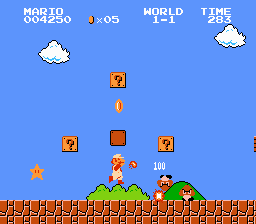
 "We are now in a digital age". We sure hear that quite a bit. Comic books have passed into the era of the digital. It all started with Shatter, the first alleged computerised comic first published in March 1985. I was really surprised at the year it all began: it's close to 25 years ago, when we weren't so much considered as being in the digital age. Video games were in 8 bit on the Nintendo Entertainment System, and Supermario Bros had just been released in Japan. I've always found video games to be a good benchmark to see technological advances, especially for comic books.
Why would video games be a good benchmark? Well simply because the comic book publishing world is far from being like the Hollywood film star world. The artists are quite humble in wealth, and resources. Comic book artists, like most published authors, work with their own means, so seeing what is available to the average family in terms of technology illustrates what's available to comic book artists. In other word, it's amazing Shatter managed to get created in 1985 when we compare it to the Nintendo games of the time.

Shatter, by Peter B. Gillis and Mike Saenz, published by First Comics brags from the first issue in 1985 on the cover of being the first computerized comic. It was first published in Big K, a computer magazine which introduced Shatter as: "the world's first comics series entirely drawn on a computer" (Big K no. 6). The first look at the inside of Shatter and you can see the pixels and the computerised effects used to create it's unique touch. Mostly, what you'll discover when you open Shatter, is that the computerised style works incredibly well! It gives the whole comic a Blade Runner/Do Androids Dream of Electric Sheep? (Ridley Scott, and Philip K. Dick respectively). The artwork in Shatter brought forth the first demonstration that involving a computer in the comic book art process works. Or at least it works if you're willing to take advantage of the computer and not try to do exactly what you were doing on paper, but on a screen.
Comic book artist which I will refer too quite extensively throughout my research work, describes on his blog how he switched to working on and with a computer when working on comic books:
http://disraeli-demon.blogspot.com/2009/08/caption-2009-ten-years-in-digital-world.html
The digital age of comic books involves just a few things: a graphics tablet (now available in A5 size for about £70), Adobe Photoshop (or other similar programs) for colour work, Adobe Illustrator (or other similar programs) for the drawing and "inking", and a word processor, to put in the text and read the now digitalised scenarios. The technological advances we are getting now days for comic books don't consist of much more than bigger, better, faster and more precise graphic tablets, improved software and improved computer hardware (although nothing heavy duty is required). As home PCs and Macs get better every day, the computerisation of comic books gets simpler. Contemporary technological advances don't seem to improve the quality of comic books though because the hardware and software involved has not had breakthroughs since the democratisation of an affordable graphics tablet. The changes made in the recent software and hardware just make working on a computer ever so slightly easier, faster, and more user friendly and adaptable, as well as portable, and this is mainly because of prices. Now most homes have a printer and a scanner which can scan in a good resolution and 300dpi, and graphic tablets are affordable. Therefore, any comic artist has the tools easily available for him to take his comics into "the digital age".

No comments:
Post a Comment