Drawing outside, in the cold, when we could have stayed inside - 26/11/09
During this week's seminar, we were asked to draw. There was no discussion, no introduction to the reason of the work we were asked to do. A brief was simply given to four teams of four. Our group studied the outdoors, a location outside, that we had to draw from different perspectives.
We went outside, to a location where the temperature was all but welcoming. We quickly decided on a spot where we would draw what we saw. Sitting down, I drew the background. I have to say, that as a designer, my drawing skills are very limited. I do not think I captured any of the "precious" essence of the location. This was more confusing than anything else. After drawing the area, drawing poorly I should actually say, we corded off a bit of the terrain we were representing in our drawings and focused on representing that on paper. Once again, my qualities in drawing did not seem to stand out, although I was told I was getting better. I felt very intimidated comparing my work to the one of the fine art students. Even Bianca had done drawing in first year of digital media.
Our representations of the corded location were very different, and the difference in our style only thickened when we went back to the studio and had to draw the location from memory. The only thing from the actual location I did want to put in my drawing from memory was a snail I created in the background of one of my drawings.
This seminar was most helpful to allow me to practice my imagination skills. Out of the most concrete situation, I created a stick-snail character which I hoped would distract from the rest of the drawing. This goes hand in hand with my comic book works. Comic books are a form of entertainment, and one of the prime roles of entertainment is to be distracted from reality, and taken into another world. The surreal of my Wally, the Evangelist snail, allows for those who would be bored by my drawings, or disturbed by my lake of skill to be able to be distracted from these harsh truths.
The seminar about nature and artistic interpretation of nature did not manage to get a lot out of me apart from my belief that all men need to be distracted from reality in order to be able to cope with everyday life. The possibility to be distracted for a bit from the cold of the outdoors, for example, allows stress relief and to be transported out of reality only to come back hopefully refreshed.
Thursday, 26 November 2009

Thursday, 19 November 2009
Anne Douglas on Paul Clay
Anne Douglas on Paul Clay – 19/11/09
Anne Douglas walked us through the works of Paul Clay. We analysed his drawings and were explained how Paul Clay saw drawing as the direct opposite of photography, and his vision of drawing as an extension of ourselves. We analysed the drawings of Paul Clay and tried to understand his view on the art of drawing. Anne Douglas explained from the start that her definition of “art” was “doing something supremely well”. One of the main focuses that we observed on Paul Clay’s drawings is the idea of referential: he called these the passive, the active and the medial. We were asked to produce a drawing ourselves illustrating a natural event that would take in consideration the referential system and the change in the active, passive and medial elements in our drawings. We then presented our drawings to the class and explained our referential system, and our representation of forces in the drawing. The class then commented not only on our representation but also on our drawing skills.
During our seminar, I tried to question Paul Clay, and could not stop be understand what he was doing what a form of pseudo-scientific representation. Paul Clay’s drawings bother me. For me, they are in direct contradiction with the definition of art given to us at the beginning of the seminar: art is doing something “supremely well”. Paul Clay does no seem to be doing his work supremely well in any perspective. His illustrations are merely pseudo-physics. The system he tries to represent with the water weal is just a very poor tae on the study of forces and referential which has been the method to analyse actions and reactions in the physics discipline for centuries. The physics idea is the same as Paul Clays with the only difference of having a consistent and logical norm of representation. When Paul Clay puts emphasis on one aspect of the forces applied to his schematics, he is simply changing the referential. In other words, he is just changing the “item” around which the whole force system is applied to.
In physics there are precise ways of drawing forces and applying them in relation to a referential. The simplest example is in the heliocentric referential, the earth goes around the Sun, but if we take the Earth as a referential, the sun is the other planets are the ones moving in an ellipsis around the Earth. Paul Clays drawings simply change referential by putting more emphasis on the water, the hammer, or the wheels.
The closest this application could be taken to my work is the importance of some items on others in the artistic representation and how one represents this emphasis. In comics, one can apply more or less emphasis on an item, an emotion or an event, and sometimes all three in the same situation consecutively. Paul Clay’s approach to drawing allows one to consider what he would like to have as the main referential in his drawing, allowing for a view of the drawing in different perspectives.
Anne Douglas walked us through the works of Paul Clay. We analysed his drawings and were explained how Paul Clay saw drawing as the direct opposite of photography, and his vision of drawing as an extension of ourselves. We analysed the drawings of Paul Clay and tried to understand his view on the art of drawing. Anne Douglas explained from the start that her definition of “art” was “doing something supremely well”. One of the main focuses that we observed on Paul Clay’s drawings is the idea of referential: he called these the passive, the active and the medial. We were asked to produce a drawing ourselves illustrating a natural event that would take in consideration the referential system and the change in the active, passive and medial elements in our drawings. We then presented our drawings to the class and explained our referential system, and our representation of forces in the drawing. The class then commented not only on our representation but also on our drawing skills.
During our seminar, I tried to question Paul Clay, and could not stop be understand what he was doing what a form of pseudo-scientific representation. Paul Clay’s drawings bother me. For me, they are in direct contradiction with the definition of art given to us at the beginning of the seminar: art is doing something “supremely well”. Paul Clay does no seem to be doing his work supremely well in any perspective. His illustrations are merely pseudo-physics. The system he tries to represent with the water weal is just a very poor tae on the study of forces and referential which has been the method to analyse actions and reactions in the physics discipline for centuries. The physics idea is the same as Paul Clays with the only difference of having a consistent and logical norm of representation. When Paul Clay puts emphasis on one aspect of the forces applied to his schematics, he is simply changing the referential. In other words, he is just changing the “item” around which the whole force system is applied to.
In physics there are precise ways of drawing forces and applying them in relation to a referential. The simplest example is in the heliocentric referential, the earth goes around the Sun, but if we take the Earth as a referential, the sun is the other planets are the ones moving in an ellipsis around the Earth. Paul Clays drawings simply change referential by putting more emphasis on the water, the hammer, or the wheels.
The closest this application could be taken to my work is the importance of some items on others in the artistic representation and how one represents this emphasis. In comics, one can apply more or less emphasis on an item, an emotion or an event, and sometimes all three in the same situation consecutively. Paul Clay’s approach to drawing allows one to consider what he would like to have as the main referential in his drawing, allowing for a view of the drawing in different perspectives.
Tuesday, 17 November 2009
Technological advances and comic books
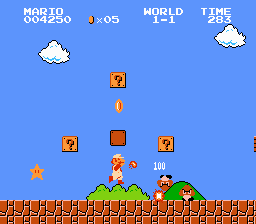 "We are now in a digital age". We sure hear that quite a bit. Comic books have passed into the era of the digital. It all started with Shatter, the first alleged computerised comic first published in March 1985. I was really surprised at the year it all began: it's close to 25 years ago, when we weren't so much considered as being in the digital age. Video games were in 8 bit on the Nintendo Entertainment System, and Supermario Bros had just been released in Japan. I've always found video games to be a good benchmark to see technological advances, especially for comic books.
Why would video games be a good benchmark? Well simply because the comic book publishing world is far from being like the Hollywood film star world. The artists are quite humble in wealth, and resources. Comic book artists, like most published authors, work with their own means, so seeing what is available to the average family in terms of technology illustrates what's available to comic book artists. In other word, it's amazing Shatter managed to get created in 1985 when we compare it to the Nintendo games of the time.
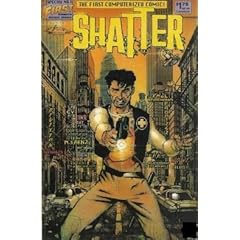
Shatter, by Peter B. Gillis and Mike Saenz, published by First Comics brags from the first issue in 1985 on the cover of being the first computerized comic. It was first published in Big K, a computer magazine which introduced Shatter as: "the world's first comics series entirely drawn on a computer" (Big K no. 6). The first look at the inside of Shatter and you can see the pixels and the computerised effects used to create it's unique touch. Mostly, what you'll discover when you open Shatter, is that the computerised style works incredibly well! It gives the whole comic a Blade Runner/Do Androids Dream of Electric Sheep? (Ridley Scott, and Philip K. Dick respectively). The artwork in Shatter brought forth the first demonstration that involving a computer in the comic book art process works. Or at least it works if you're willing to take advantage of the computer and not try to do exactly what you were doing on paper, but on a screen.
Comic book artist which I will refer too quite extensively throughout my research work, describes on his blog how he switched to working on and with a computer when working on comic books:
http://disraeli-demon.blogspot.com/2009/08/caption-2009-ten-years-in-digital-world.html
The digital age of comic books involves just a few things: a graphics tablet (now available in A5 size for about £70), Adobe Photoshop (or other similar programs) for colour work, Adobe Illustrator (or other similar programs) for the drawing and "inking", and a word processor, to put in the text and read the now digitalised scenarios. The technological advances we are getting now days for comic books don't consist of much more than bigger, better, faster and more precise graphic tablets, improved software and improved computer hardware (although nothing heavy duty is required). As home PCs and Macs get better every day, the computerisation of comic books gets simpler. Contemporary technological advances don't seem to improve the quality of comic books though because the hardware and software involved has not had breakthroughs since the democratisation of an affordable graphics tablet. The changes made in the recent software and hardware just make working on a computer ever so slightly easier, faster, and more user friendly and adaptable, as well as portable, and this is mainly because of prices. Now most homes have a printer and a scanner which can scan in a good resolution and 300dpi, and graphic tablets are affordable. Therefore, any comic artist has the tools easily available for him to take his comics into "the digital age".
Thursday, 12 November 2009
François Matarasso
François Matarasso – 12/11/09
During our seminar with François Matarasso we discussed how the government discusses about the quality of art, and how they use these discussions to decide on their funding and censorship of art. François Matarasso explained to us how he was the one charged of finding the criteria to base the discussions on the quality or art produced by individuals or groups funded by the government. He came up with five criteria to “guide the discussion”, and he was very clear to mention that these criteria were not made to assess or grade the art, but really just to guide a discussion. His five criteria were:
1: Technique/mastery
2: Originality
3: Ambition
4: Resonance
5: Feeling
After the discussion with Matarasso, which chose his words very carefully to make sure we could not interpret anything he said as judgement, it still seemed that Matarasso’s criteria were not only to guide a discussion, mainly because no matter how his great eloquence avoided the subject, he was part of the group that judged artists. These criteria were very specific to the government funded art, and does not have much of a link to publication or artwork funded by a private source. The main question for me was “who was he to judge?” And even if he was not judging, why was he the one that thought he had to set these criteria for “a better discussion”?
After long reflections about if people would use these criteria to judge my artwork and my designs, I have to say I was ill convinced of their usefulness in the comic book world. Although they can apply to government funded projects, comic books are simply linked to the publishing business, and the main criteria in business is “can it make a profit?” Although on the purely artistic point of view, comic books have quite a limited spectrum: they are a narration method, therefore have for sole purpose to tell a story. The story in itself can be put through these criteria and have many functions such as entertainment, political discussion, comedy,… but the design, the technique that transmits the message is even more limited. The comic book design has for objective to tell a story. We could try to apply Matarasso’s criteria to the comic book design:
1: Technique/mastery – The technique of comic book design is how effectively one can enhance and use the message to make the narration have a greater impact on the reader. The main technique in comic book design is choosing which type of design will reinforce the narration.
2: Originality – That criteria is not a simple one seeing as the comic book design technique does not have many variations. Although new ones are introduced little by little, they only tend to work with very specific style of stories.
3: Ambition – I don’t think ambition can really apply to the comic book design. The design is about effectiveness and efficiency.
4: Resonance – It is suppose to be the link with the world. Resonance is probably the main criteria that should be used regarding comic book design: the link between design, narration and story is of the highest importance.
5: Feeling – This criteria seems to be the most subjective. I cannot even fine a precise definition of “feeling” that would apply in this case. I suppose that when one has a very subjective criteria, one cannot be judged for judging.
During our seminar with François Matarasso we discussed how the government discusses about the quality of art, and how they use these discussions to decide on their funding and censorship of art. François Matarasso explained to us how he was the one charged of finding the criteria to base the discussions on the quality or art produced by individuals or groups funded by the government. He came up with five criteria to “guide the discussion”, and he was very clear to mention that these criteria were not made to assess or grade the art, but really just to guide a discussion. His five criteria were:
1: Technique/mastery
2: Originality
3: Ambition
4: Resonance
5: Feeling
After the discussion with Matarasso, which chose his words very carefully to make sure we could not interpret anything he said as judgement, it still seemed that Matarasso’s criteria were not only to guide a discussion, mainly because no matter how his great eloquence avoided the subject, he was part of the group that judged artists. These criteria were very specific to the government funded art, and does not have much of a link to publication or artwork funded by a private source. The main question for me was “who was he to judge?” And even if he was not judging, why was he the one that thought he had to set these criteria for “a better discussion”?
After long reflections about if people would use these criteria to judge my artwork and my designs, I have to say I was ill convinced of their usefulness in the comic book world. Although they can apply to government funded projects, comic books are simply linked to the publishing business, and the main criteria in business is “can it make a profit?” Although on the purely artistic point of view, comic books have quite a limited spectrum: they are a narration method, therefore have for sole purpose to tell a story. The story in itself can be put through these criteria and have many functions such as entertainment, political discussion, comedy,… but the design, the technique that transmits the message is even more limited. The comic book design has for objective to tell a story. We could try to apply Matarasso’s criteria to the comic book design:
1: Technique/mastery – The technique of comic book design is how effectively one can enhance and use the message to make the narration have a greater impact on the reader. The main technique in comic book design is choosing which type of design will reinforce the narration.
2: Originality – That criteria is not a simple one seeing as the comic book design technique does not have many variations. Although new ones are introduced little by little, they only tend to work with very specific style of stories.
3: Ambition – I don’t think ambition can really apply to the comic book design. The design is about effectiveness and efficiency.
4: Resonance – It is suppose to be the link with the world. Resonance is probably the main criteria that should be used regarding comic book design: the link between design, narration and story is of the highest importance.
5: Feeling – This criteria seems to be the most subjective. I cannot even fine a precise definition of “feeling” that would apply in this case. I suppose that when one has a very subjective criteria, one cannot be judged for judging.
Wednesday, 11 November 2009
Mixing realities
Real life has quite often been translated directly into comic books. Fluide Glaciale, a franco-belgian adult comic book magazine that has been running since 1975. One of the first adult comic publications after the amendment of:
The law "n°49.956 of the 16 July 1949" which imposes censorship on comics which portray in any positive manner: "lying, stealing, debauchery, hatred, cowardliness, laziness, (and from 1954) ethnic prejudice" (Mouchart, B., 2003, p. 25).
Fluide Glaciale has since 1975 published comic series of pictures layed out and narrated as a comic book. As can be seen in this extract from Fluide Glaciale, Gay Friendly, Serie Or #30, 2005

This medium of comics does not really work for me because of the fact that it's just "too real". Like many other entertainment media, comic books are there to take people away from their daily lifes to another person's or even to magical fantasy lands.
My vision of a cross media comic book is further from reality. Drawing via a graphic tablet on digital photos is a way of putting together comic books which is actually extremly appealing to me. Although it has to be done in a specific way: picture background and cartoon characters. I cannot bare the idea of the opposite. It has been done many times, and mainly through the 1988 famous movie Who Framed Roger Rabbit (memorable not only because of its cross media effects but also for being the only Warner Brothers and Disney collaboration). This can also be seen in the Disney classic Mary Poppins when the main characters go into a fantasy picture where all the special effects were cartoons.
I don't think anyone can compete, even nowadays, with Roger Rabbit.
My adaptation of this technique, using only Adobe Photoshop and a graphics tablet gives this:

This is far from being as legendary as Roger Rabbit, but the harshness of reality against the thick clumbsy lines of my novice graphics tablet brush strokes create a contrast which is greatly inspired from Who Framed Roger Rabbit. Like the movie, this brings cartoon characters to our world, allowing us to identify with them, while keeping a safe distance with fantasy.
The law "n°49.956 of the 16 July 1949" which imposes censorship on comics which portray in any positive manner: "lying, stealing, debauchery, hatred, cowardliness, laziness, (and from 1954) ethnic prejudice" (Mouchart, B., 2003, p. 25).
Fluide Glaciale has since 1975 published comic series of pictures layed out and narrated as a comic book. As can be seen in this extract from Fluide Glaciale, Gay Friendly, Serie Or #30, 2005

This medium of comics does not really work for me because of the fact that it's just "too real". Like many other entertainment media, comic books are there to take people away from their daily lifes to another person's or even to magical fantasy lands.
My vision of a cross media comic book is further from reality. Drawing via a graphic tablet on digital photos is a way of putting together comic books which is actually extremly appealing to me. Although it has to be done in a specific way: picture background and cartoon characters. I cannot bare the idea of the opposite. It has been done many times, and mainly through the 1988 famous movie Who Framed Roger Rabbit (memorable not only because of its cross media effects but also for being the only Warner Brothers and Disney collaboration). This can also be seen in the Disney classic Mary Poppins when the main characters go into a fantasy picture where all the special effects were cartoons.
I don't think anyone can compete, even nowadays, with Roger Rabbit.
My adaptation of this technique, using only Adobe Photoshop and a graphics tablet gives this:

This is far from being as legendary as Roger Rabbit, but the harshness of reality against the thick clumbsy lines of my novice graphics tablet brush strokes create a contrast which is greatly inspired from Who Framed Roger Rabbit. Like the movie, this brings cartoon characters to our world, allowing us to identify with them, while keeping a safe distance with fantasy.
Monday, 9 November 2009
Telling a story
Comic books are all about telling a story. It can be seen as a mix of a graphic and written medium, but that doesn't change the purpose of the comic book being to put a narrative across. Narratives can be extremely simple, or very complicated. The comic book as a narrative medium has evolved quite a bit since "the golden age of comic" (late 1930s to late 1940s). At the time the merging between text and images was a new idea, and the textual medium would overwhelm the comic book. In the very first Judge Dredd comics for example, the authors wrote what the Judge was doing in the picture. Is it really necessary to describe the picture with text? That goes against the whole principle of comic books have text and images working hand in hand, it was more of a free for all at first.

Steve Gerber & Stever Brunner, Howard the Duck #1, Marvel Comics, 1976
There is no sense to discribing the image by sense. The drawing already does the job of telling you the part of the story it illustrates. Having thought or speach bubbles or a narrator explaining what can already be observed in the artwork is redoundant.
This can be seen as a very clumsy way of using the comic book medium. As comics evolved through time, text would be less and less present and a real balance of words and pictures was established. In fact mangas like Priest would take things the other way and have entire volumes of mangas with very little text. This lead to a lot of pictures to say very few words.


4 consecutive pages from a French copy of:
Hyung Min-Woo, Priest, Editions Tokebi, 2004
Most of the Priest series is like these 4 pages: a lot of images, and virtualy no text. This makes for a very fast read of the volumes because there is not that much to read on each page. The pictures do not tell us much, but illustrate a almost second by second scene of Priest. This is the opposite from the Howard the Duck example, the difference is that the scarce text has a contemporary artistic justification: the author purposely wants to have no text and narrate the story only through pictures. Howard the Duck does not have that luxury because of the historical background: the medium had not been fully exploited and explored, and comic books were still very much an "underground" medium, therefore the clumsiness of the first comic book artists.
PS: Steve Gerber, if you ever read this, Howard is one of my idols and the best ever Marvel Comics superhero!

Steve Gerber & Stever Brunner, Howard the Duck #1, Marvel Comics, 1976
There is no sense to discribing the image by sense. The drawing already does the job of telling you the part of the story it illustrates. Having thought or speach bubbles or a narrator explaining what can already be observed in the artwork is redoundant.
This can be seen as a very clumsy way of using the comic book medium. As comics evolved through time, text would be less and less present and a real balance of words and pictures was established. In fact mangas like Priest would take things the other way and have entire volumes of mangas with very little text. This lead to a lot of pictures to say very few words.


4 consecutive pages from a French copy of:
Hyung Min-Woo, Priest, Editions Tokebi, 2004
Most of the Priest series is like these 4 pages: a lot of images, and virtualy no text. This makes for a very fast read of the volumes because there is not that much to read on each page. The pictures do not tell us much, but illustrate a almost second by second scene of Priest. This is the opposite from the Howard the Duck example, the difference is that the scarce text has a contemporary artistic justification: the author purposely wants to have no text and narrate the story only through pictures. Howard the Duck does not have that luxury because of the historical background: the medium had not been fully exploited and explored, and comic books were still very much an "underground" medium, therefore the clumsiness of the first comic book artists.
PS: Steve Gerber, if you ever read this, Howard is one of my idols and the best ever Marvel Comics superhero!
Thursday, 5 November 2009
Thomas Hirschhorn Exhibition
The Thomas Hirschhorn Exhibition, Dundee - 05/11/09
Thomas Hirschhorn exhibition was like entering a whole new world where bits and pieces from our own had been taken from anywhere available and collaged together to make pictures, paintings, statues, sculptures and devices. This form of collage brought together items dramatically different meticulously placed amongst each other to accentuate contrast. May it be from small plastic robots held together with tape to carefully designed colossal statues; everything had a feel of recycled items. On a design perspective, Thomas Hirschhorn has perfected the art of making other people’s work his own, and rightfully so, by recycling logos and old items to create something new with a deep meaning to it.
From the start, I greatly connected with the work of Thomas Hirschhorn. I have greatly reflected on my own work after seeing his “Ur-Collage” and “Where do I stand? What do I want?” His work touches me mainly because I cannot stop from making assimilation with the cyber-punk and steam-punk genres and his work. Those two genres are like his work: collage, a mix of worlds, technology, techniques and philosophies. The deliberate choice of simple magazine collage techniques gives the artwork a sense of reality. This technique makes the idea of photoshoped pictures and airbrushed photomontages seem distant and put reality back in the realm of the real, and not the glamorised and over-dramatised media.
The work of Thomas Hirschhorn made me reflect a lot about my own work and my preferred technique of perverting man made industrial type objects from their original purpose, may it be as simple as transforming the wall of a squat into a curatorial space. The closest I do feel with the work of Thomas Hirschhorn is the mix of genres, techniques, and subjects, which I have applied to my mix media comics with real photos drawn over with a graphics tablet. Although I use this means to accomplish the opposite of his: I try to use this technique as a way of getting away from reality, when he uses it to make people more aware of reality.
The exhibition of Thomas Hirschhorn is immersive and manages to totally capture the mind of the viewers into his own world. This is what I have been trying to achieve with spray painted comic books, and what I intend to do with spray painted life size characters on the same wall I have already started working on. My ideal with this type of work is to get the spectators into the world created for them and to make them discover something new. The layout of the exhibition is designed in such ways that there is no other option for the spectator than to be part of the new reality created for them. One of my objectives is to gather all the inspiration taken from this exhibition and create my own curatorial comic book space with sole purpose being the total immersion of viewers into the comic book world.
Thomas Hirschhorn exhibition was like entering a whole new world where bits and pieces from our own had been taken from anywhere available and collaged together to make pictures, paintings, statues, sculptures and devices. This form of collage brought together items dramatically different meticulously placed amongst each other to accentuate contrast. May it be from small plastic robots held together with tape to carefully designed colossal statues; everything had a feel of recycled items. On a design perspective, Thomas Hirschhorn has perfected the art of making other people’s work his own, and rightfully so, by recycling logos and old items to create something new with a deep meaning to it.
From the start, I greatly connected with the work of Thomas Hirschhorn. I have greatly reflected on my own work after seeing his “Ur-Collage” and “Where do I stand? What do I want?” His work touches me mainly because I cannot stop from making assimilation with the cyber-punk and steam-punk genres and his work. Those two genres are like his work: collage, a mix of worlds, technology, techniques and philosophies. The deliberate choice of simple magazine collage techniques gives the artwork a sense of reality. This technique makes the idea of photoshoped pictures and airbrushed photomontages seem distant and put reality back in the realm of the real, and not the glamorised and over-dramatised media.
The work of Thomas Hirschhorn made me reflect a lot about my own work and my preferred technique of perverting man made industrial type objects from their original purpose, may it be as simple as transforming the wall of a squat into a curatorial space. The closest I do feel with the work of Thomas Hirschhorn is the mix of genres, techniques, and subjects, which I have applied to my mix media comics with real photos drawn over with a graphics tablet. Although I use this means to accomplish the opposite of his: I try to use this technique as a way of getting away from reality, when he uses it to make people more aware of reality.
The exhibition of Thomas Hirschhorn is immersive and manages to totally capture the mind of the viewers into his own world. This is what I have been trying to achieve with spray painted comic books, and what I intend to do with spray painted life size characters on the same wall I have already started working on. My ideal with this type of work is to get the spectators into the world created for them and to make them discover something new. The layout of the exhibition is designed in such ways that there is no other option for the spectator than to be part of the new reality created for them. One of my objectives is to gather all the inspiration taken from this exhibition and create my own curatorial comic book space with sole purpose being the total immersion of viewers into the comic book world.
Wednesday, 4 November 2009
Don't take that so litteraly!

There the ones who put it up!

Yeah... You can get anything out of anything if you look hard enough

They should make those signs clearer. Drinky Crow got confused as well. A suicide hotline doesn't mean they should try to stop you from committing suicide, foot fetish hotlines don't try to get you out of your foot fetish.
"Vandalising" or curating the world!
Vandalising is a word which suggests some malicious idea...


Vandalise
/ˈvæn.dəl.aɪz/ v [T]
to intentionally damage property belonging to other people

The only loop-hole in that definition is the word "damage". I don't think I'm damaging the property of others, I'm enhancing it in a positive way. So far I only have 2 places I've worked on: a stool in the St. Nicholas' Kirk graveyard.

I really like the idea of writing on things that don't belong where they are. Like a 1960's in the middle of a graveyard in the centre of town. I like the "take that society" just because it is what everyone is trying to say in one way or the other when they do vandalism. The humour in it is that anyone who writes on walls is trying to say "take that society" in the most complex way their artistic spirit can come up with. I decide to revert to the most basic message state and have stick-people comment on my "take that society".

In the area (on the border of Woodside and Tillydrone) where I spray painted quite poorly this first piece of my curatorial exhibit was, in my defence, my first ever spay painted stencil on a wall, at night (and it was very very dark). The challenge with this entire wall, that I intend to apply my spray painted short comics, is to find a quite universally understandable message. I think "why not consider abduction" has a universal social appeal, plus, I feel I'm doing my part to help aliens probe the world. The stick-man and the spray painting medium have something that reminds of stone age art and cave-wall paintings. I am hoping that if found in the future, this mural would be analysed as are cave-men drawings now. I just feel that despite all our technology, the best way to carve something in stone, is to carve it in stone... or spray paint it on a wall.


In the area (on the border of Woodside and Tillydrone) where I spray painted quite poorly this first piece of my curatorial exhibit was, in my defence, my first ever spay painted stencil on a wall, at night (and it was very very dark). The challenge with this entire wall, that I intend to apply my spray painted short comics, is to find a quite universally understandable message. I think "why not consider abduction" has a universal social appeal, plus, I feel I'm doing my part to help aliens probe the world. The stick-man and the spray painting medium have something that reminds of stone age art and cave-wall paintings. I am hoping that if found in the future, this mural would be analysed as are cave-men drawings now. I just feel that despite all our technology, the best way to carve something in stone, is to carve it in stone... or spray paint it on a wall.

Sunday, 1 November 2009
The infamous to-do-list for the first semester!
Lists work well with me, so lets start doing one.
Comic ideas to exploit:
-God's Second Chance : continue working on the stickman based comic. As the comic evolves the style should evolve as well. This is the perfect way to work on the merging of hand-drawn comic books with the digital/computerised ones.
-Long John Willbert McLeod, hobbo : short stories based on the everyday man: a mentally ill homeless man. The work on Willbert will be mainly by hand and will allow to explore the traditional hand drawn techniques and what work is needed using this to narrate stories effectively. This the technique I think will be most effective to analyse what the most efficient comic design is.
-1001 Uses for a BB-Gun : I have to say, it does what it says on the tin. I was thinking of using a very user friendly digital comic book program. This would give me a very good view of how easy it has become to create a comic book from scratch with no particular artistic or design skills needed.
-You have a geek! : purely computer based comic book illustrating traits which would help one recognise the infamous geek. This will me done in the opposite way of my hobbo comics: purely digital (if possible). This comic book will explore the purely digital format for comic books.
Here's a taster:

Comic ideas to exploit:
-God's Second Chance : continue working on the stickman based comic. As the comic evolves the style should evolve as well. This is the perfect way to work on the merging of hand-drawn comic books with the digital/computerised ones.
-Long John Willbert McLeod, hobbo : short stories based on the everyday man: a mentally ill homeless man. The work on Willbert will be mainly by hand and will allow to explore the traditional hand drawn techniques and what work is needed using this to narrate stories effectively. This the technique I think will be most effective to analyse what the most efficient comic design is.
-1001 Uses for a BB-Gun : I have to say, it does what it says on the tin. I was thinking of using a very user friendly digital comic book program. This would give me a very good view of how easy it has become to create a comic book from scratch with no particular artistic or design skills needed.
-You have a geek! : purely computer based comic book illustrating traits which would help one recognise the infamous geek. This will me done in the opposite way of my hobbo comics: purely digital (if possible). This comic book will explore the purely digital format for comic books.
Here's a taster:

Subscribe to:
Comments (Atom)